


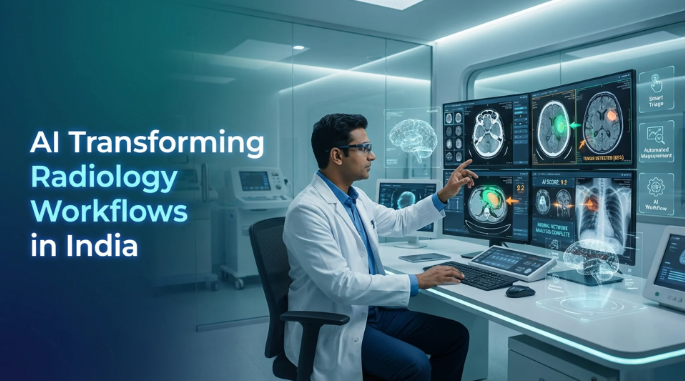
The Indian healthcare system is evolving rapidly, and radiology sits at the center of this change. With rising patient volumes, a shortage of trained radiologists, and increasing expectations for faster diagnostics, Artificial Intelligence (AI) is becoming a critical enabler rather than a future concept.
RadpicsAI is integrating AI directly into PACS (Picture Archiving and Communication Systems), helping healthcare providers streamline operations, improve diagnostic accuracy, and deliver better patient outcomes.
Why AI in Radiology is Growing in India
India faces a unique imbalance between demand and capacity in diagnostics. Imaging volumes are increasing across urban and semi-urban centers, while the number of radiologists remains limited. At the same time, there is a strong push toward digital healthcare infrastructure.
AI-powered systems are helping bridge this gap by enabling radiologists to work more efficiently without compromising on quality. As a result, terms like AI in radiology India, AI-powered PACS, automated reporting, and teleradiology are becoming central to healthcare discussions.
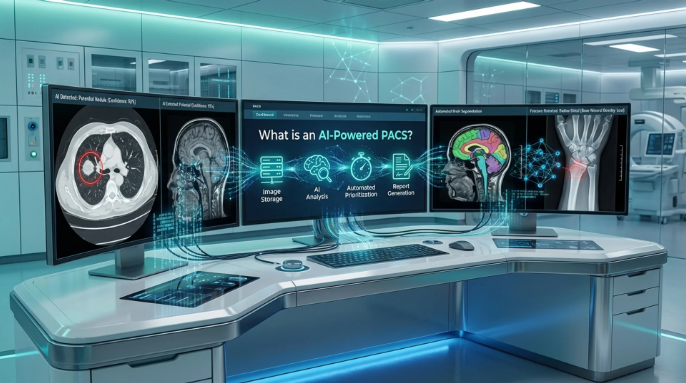
What is an AI-Powered PACS?
A traditional Picture Archiving and Communication System. is designed to store, retrieve, and display medical images. An AI-powered PACS builds on this foundation by introducing intelligence into the workflow.
It can automatically analyze images, prioritize urgent cases, assist in diagnosis, and generate structured reports. This transforms PACS from a passive storage system into an active participant in the diagnostic process.
Real Use Cases of AI Inside PACS
- Smart Case Prioritization — Radiology departments often deal with high volumes of cases, making it difficult to identify critical scans quickly. AI addresses this by analyzing incoming images in real time and flagging urgent cases such as intracranial hemorrhages or severe lung abnormalities. These cases are automatically pushed to the top of the worklist, ensuring they are reviewed first. This significantly improves response time in emergency situations.
- Automated Preliminary Reporting — Report generation is one of the most time-consuming aspects of radiology workflows. AI can assist by analyzing scans and generating structured draft reports that include key findings. Radiologists can then review, edit, and finalize these reports. This reduces turnaround time while maintaining clinical oversight and accuracy.
- AI-Assisted Diagnosis — AI acts as a support system for radiologists by highlighting suspicious regions and identifying potential abnormalities. It can detect early signs of diseases such as tuberculosis, fractures, or lung infections, and provide probability-based insights. This is particularly valuable in high-pressure environments where speed and precision are both critical.
- Teleradiology and Remote Access — AI-powered PACS platforms like RadpicsAI allow radiologists to access and interpret scans from any location. This supports teleradiology models, enabling experts in urban centers to report for facilities in smaller cities and rural areas. It helps bridge the accessibility gap and ensures that patients receive timely diagnoses regardless of their location.
- Workflow Automation and Case Allocation — Managing workflows manually can lead to inefficiencies and delays. AI-powered PACS systems can automatically assign cases based on radiologist expertise, availability, and workload. This ensures optimal resource utilization and helps maintain consistent turnaround times across the system.
- Quality Control and Error Reduction — AI also plays a role in improving diagnostic quality. It can act as a secondary check by identifying missed findings or inconsistencies in reports.
This reduces the chances of human error and strengthens overall patient safety.
Why Embedding AI Into PACS — Not Beside It — Changes Everything
Radiology in India doesn't suffer from a shortage of skilled doctors. The real problem lies in how work actually moves through the system. Scans keep growing in volume, but the tools and processes radiologists rely on haven't kept pace — resulting in delayed reports, messy workflows, and teams under constant pressure.
AI is often sold as the big fix. But the real change isn't about simply "adding AI." It's about where that intelligence lives and how naturally it fits into a radiologist's daily routine.
Standalone AI tools can be powerful, but they push radiologists out of their main systems — forcing screen switches, context shifts, and extra mental load. That's friction, not help. When AI is embedded inside PACS, it runs quietly in the background, processes studies as they come in, and surfaces insights at the right moment — often without the radiologist having to lift a finger.
In busy departments, this changes everything. Critical findings are flagged automatically as soon as a scan arrives. Radiologists no longer plow through long queues in order — they start with the most urgent cases, which often translates directly into better patient outcomes.
Reporting shifts too. With AI built into the system, key findings, measurements, and structured inputs are already laid out in the reporting interface. Radiologists don't start from blank pages anymore — they review, refine, and sign off. The role moves from writing everything from scratch to editing and validating, which speeds things up without sacrificing accuracy.
When PACS is properly connected to other hospital systems, the entire workflow becomes smoother. Scans move predictably from machine to worklist, findings are documented without extra clicks, and reports reach clinicians on time. What once felt like disconnected steps starts to look like a single, continuous flow.
This is especially important in India's context. Demand for imaging is growing fast, radiologists are unevenly spread, and rural areas struggle to find specialists. AI-powered PACS helps by making it possible to handle more work without necessarily adding more staff — enabling centralized reporting, efficient work-sharing, and multi-location contribution. Teleradiology slots in naturally: when AI is part of the core system, remote radiologists see the same priorities, the same insights, and the same structured workflows as those on-site.
The value of AI, ultimately, isn't measured by how impressive it looks in isolation — it's measured by how well it fits into the tools and routines radiologists already use every day.
Benefits of AI in Radiology Workflows
The integration of AI into radiology workflows is delivering measurable improvements across healthcare facilities in India. These include faster reporting times, increased case handling capacity, reduced operational costs, and improved diagnostic consistency.
Radiologists benefit from reduced workload and fatigue, while patients receive quicker and more accurate diagnoses. Additionally, AI enables healthcare providers to extend diagnostic services to underserved regions.
Emerging Trends in AI Radiology
AI adoption in radiology is continuing to evolve, with several key trends shaping the future of the field.
Multimodal AI is gaining traction by combining imaging data with patient history and clinical records to provide more comprehensive insights. Cloud-based PACS systems are enabling scalability and remote access, reducing the need for heavy infrastructure investments.
AI is also being used in large-scale screening programs, particularly for conditions like tuberculosis and lung diseases, which are highly relevant in the Indian context. Voice-enabled reporting tools are further simplifying workflows by allowing radiologists to dictate findings directly into structured formats.
Challenges and the Path Forward
While the benefits are clear, adoption of AI in India does come with challenges. Data standardization remains an issue across different healthcare systems, and cost sensitivity can slow down adoption in smaller centers. There is also a learning curve associated with new technologies.
However, Modern platforms such as RadpicsAI are addressing these challenges through cloud deployment, standardized protocols, and user-friendly interfaces that require minimal training.
The Future of Radiology Workflows in India
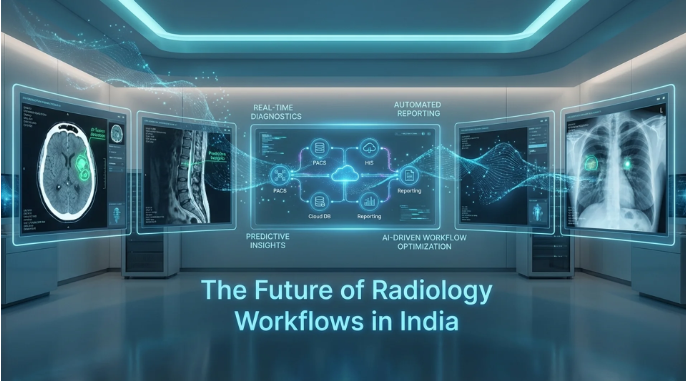
AI is not just improving radiology workflows; it is redefining them. As technology continues to advance, we can expect more integrated systems where diagnostics, reporting, and patient management are seamlessly connected.
The future of radiology will likely include real-time AI-assisted diagnostics, predictive healthcare insights, and deeper integration with hospital information systems. Radiology will move toward a more proactive and data-driven approach.
Final Thoughts
AI-powered PACS is transforming how radiology functions in India. From faster reporting and smarter case prioritization to improved accessibility and accuracy, the impact is significant and growing.
Platforms like RadpicsAI are at the forefront of this transformation, bringing together AI, cloud technology, and workflow automation into a unified ecosystem.
For healthcare providers, adopting AI is no longer just an advantage. It is becoming a necessary step toward delivering efficient, scalable, and high-quality diagnostic care.
Frequently Asked Questions
What is an AI-powered PACS in radiology?
An AI-powered PACS is an advanced imaging system that not only stores and displays scans but also analyzes images, prioritizes urgent cases, and assists in generating reports.
How is AI improving radiology workflows in India?
AI helps radiologists manage high volumes by automating repetitive tasks, highlighting critical cases, and reducing report turnaround time while improving accuracy.
Can AI replace radiologists?
No, AI supports radiologists by acting as a decision-assistance tool. It enhances efficiency but does not replace clinical judgment.
What are the benefits of AI in radiology departments?
Key benefits include faster reporting, improved diagnostic accuracy, reduced workload, better case management, and enhanced patient outcomes.
How does AI help in teleradiology?
AI enables remote access to scans, prioritizes cases, and ensures consistent workflows, allowing radiologists to report from anywhere efficiently.
Why is embedding AI into PACS important?
Embedding AI within PACS ensures seamless workflows, eliminates system switching, and delivers real-time insights directly within the radiologist’s working environment.