


Radiology departments today are under constant pressure to deliver faster reports without compromising accuracy. Imaging volumes continue to grow, case complexity is increasing, and clinicians expect near-real-time reporting. Yet in many hospitals, the workflow surrounding diagnostic imaging has not evolved at the same pace.
Much of the delay in reporting does not come from interpretation itself, but from the steps that happen around it — loading images, switching between systems, performing manual measurements, formatting reports, and coordinating between technicians, radiologists, and referring doctors.
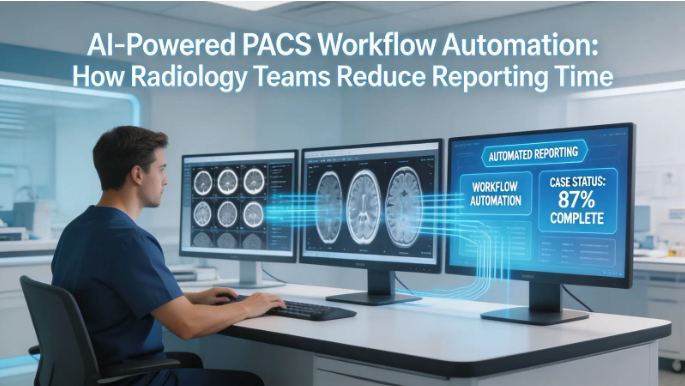
This is where PACS workflow automation powered by AI is beginning to transform radiology operations. By integrating imaging, reporting, and intelligent automation into a single environment, radiology teams are reducing turnaround times while improving consistency and efficiency.
AI-powered PACS workflow automation integrates radiology workflow AI with intelligent reporting systems to streamline hospital imaging operations and significantly reduce reporting turnaround times.
Why Traditional PACS Workflows Slow Down Reporting
Most hospitals rely on PACS systems that were originally designed for image storage and viewing, not for modern, high-volume reporting environments. Over time, additional tools were added for reporting, measurements, dictation, and sharing, resulting in fragmented workflows.
A typical radiology case may involve multiple steps across different systems. Images are opened in PACS, measurements are performed manually, findings are typed into a reporting tool, and the final report is shared through another platform. Each switch adds time, and small delays accumulate across dozens of cases each day.
This fragmentation makes it difficult to maintain speed, especially when workloads increase. Radiologists often spend as much time managing the workflow as they do reading the scan. The result is longer reporting times, higher fatigue, and reduced productivity.
How AI Is Changing the Radiology Workflow
AI-driven workflow automation is not about replacing PACS. Instead, it enhances PACS by connecting imaging, reporting, and automation into one intelligent system.
With AI radiology workflow tools like RadpicsAI, routine tasks can be handled automatically, allowing radiologists to focus on interpretation rather than process management.
One of the first improvements comes from structured reporting. Instead of starting with a blank document, the system generates a template based on modality, anatomy, and clinical indication. This reduces documentation time and ensures consistency across reports.
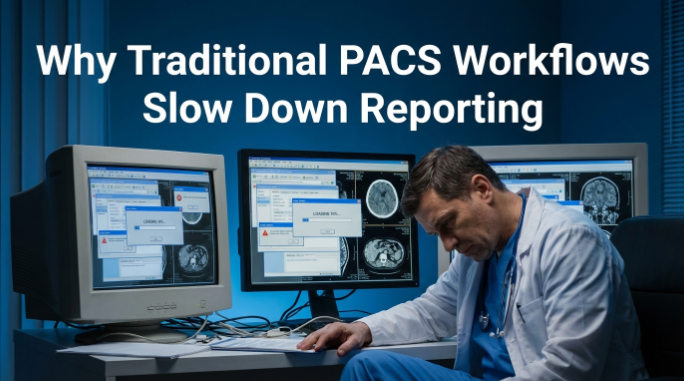
Image handling also becomes faster. AI-enabled viewers can render 2D and 3D images instantly, eliminating delays that often occur with older workstations. Measurements that normally require manual effort can be detected and calculated automatically, saving valuable minutes in every case.
Voice-to-text reporting further reduces typing time, allowing radiologists to dictate naturally while the system formats the report in real time. When all these features work together inside a unified platform, the entire reporting process becomes smoother and more reliable.
PACS Workflow Automation in High-Volume Radiology Departments
In high-volume environments, even small inefficiencies can create significant delays. A few extra minutes per case quickly turns into hours by the end of the day.
AI-powered PACS workflow automation helps by reducing the number of manual steps required to complete each report. Images load faster, measurements are pre-generated, templates are ready, and reports can be reviewed and signed without moving between multiple applications.
This leads to measurable improvements in reporting speed. Many radiology teams adopting automated workflows report turnaround time reductions of 40 to 70 percent, depending on case type and reporting complexity.
More importantly, the workflow becomes less stressful. Radiologists spend less time on repetitive tasks and more time on clinical decision-making, which improves both accuracy and job satisfaction.
Improving Collaboration Across the Radiology Team
Modern radiology is rarely a single-person process. Technicians, radiologists, referring physicians, and administrators all interact with the imaging workflow. When systems are disconnected, communication slows down.
AI-enabled diagnostic imaging software allows all parts of the workflow to remain connected. Images, reports, annotations, and measurements can be shared instantly without exporting files or switching platforms. Local reporting also becomes easier, enabling radiologists to review studies from different locations without loss of performance.
For hospitals and diagnostic centres, this means a more reliable and scalable radiology workflow that can handle growing demand without increasing operational complexity.
Healthcare systems today are expected to deliver faster results with limited resources. Radiology is at the center of this challenge because almost every clinical decision depends on imaging. Improving PACS efficiency is no longer just a technology upgrade. It is an operational necessity. When reporting becomes faster and more consistent, patients receive results sooner, clinicians can act earlier, and hospitals can manage higher volumes without compromising quality. AI-powered workflow automation makes this possible by reducing the friction that slows down reporting.
The Future of AI in Radiology Workflow
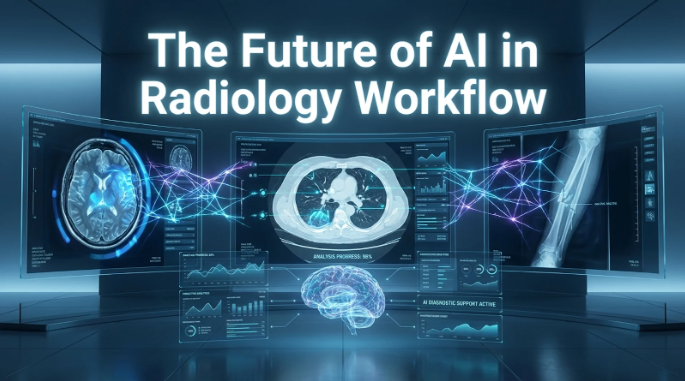
As AI continues to evolve, workflow automation will go beyond templates and measurements. Future systems will assist with case prioritisation, predictive analysis, and real-time clinical guidance. Reporting will become more connected, more mobile, and more intelligent.
Radiology teams that adopt automated workflows early are already seeing the benefits. Faster reporting, better accuracy, and lower fatigue are not theoretical outcomes — they are practical results of a more efficient workflow.
The goal is not to change the role of the radiologist, but to give radiologists the tools they need to work at their best.
Conclusion
AI-powered PACS workflow automation is helping radiology teams reduce reporting time while improving consistency and efficiency. By integrating imaging, reporting, and automation into a MedPACS™ AI-Powered Imaging Radiology Solution by RadpicsAI, hospitals can handle growing workloads without increasing stress on clinicians.
As imaging volumes continue to rise, intelligent workflow solutions will play a key role in keeping radiology fast, accurate, and sustainable.
Frequently Asked Questions
What is PACS workflow automation in radiology?
PACS workflow automation refers to the use of artificial intelligence and integrated software tools to streamline radiology processes such as image loading, measurements, report generation, and data sharing. By automating repetitive tasks, PACS workflow automation helps radiologists focus more on image interpretation and clinical decision-making.
How does AI improve PACS workflow efficiency?
AI improves PACS workflow efficiency by automating routine tasks like structured reporting, image measurements, case prioritisation, and voice-to-text dictation. These capabilities reduce manual effort and system switching, allowing radiologists to complete reports faster while maintaining accuracy.
Can AI-powered PACS reduce radiology reporting turnaround time?
Yes. Many hospitals and diagnostic centres report significant improvements in reporting speed after adopting AI-powered PACS workflow automation. By eliminating manual steps and integrating imaging, analysis, and reporting into one platform, reporting turnaround time can often be reduced by 40–70%.
Does AI replace radiologists in PACS-based workflows?
No. AI in PACS workflows is designed to support radiologists rather than replace them. AI handles repetitive tasks such as measurements and formatting, while radiologists remain responsible for clinical interpretation, diagnosis, and final report validation.
What features should hospitals look for in an AI-powered PACS system?
Hospitals should look for features such as integrated DICOM viewers, automated measurements, structured reporting templates, AI-assisted analysis, voice-enabled reporting, cloud accessibility, and seamless integration with existing hospital systems.