


After years in radiology, I have come to a clear realisation: diagnosis is rarely the hardest part of the job. The real challenge lies in everything that surrounds it.
Most people assume radiologists spend their time closely examining images and making critical clinical decisions. In reality, a significant portion of the day is consumed by repetitive and mechanical tasks-manual measurements, formatting reports, switching between systems, waiting for reconstructions to load, and re-entering the same information over and over again.
None of this work is complex. Yet it slowly chips away at time, focus, and energy. Over time, the fatigue becomes noticeable-not because the clinical work is overwhelming, but because the workflow is.
For a long time, I accepted this as part of the profession.
Why the Pressure Keeps Increasing
Radiology workloads today are fundamentally different from what they were even a decade ago. Imaging volumes have grown rapidly across CT, MRI, ultrasound, and X-ray. Expectations around turnaround times are tighter, and clinical teams depend on faster reporting to make treatment decisions.
At the same time, the number of radiologists has not increased at the same pace. This mismatch creates constant pressure. More cases. Less time per case. Higher mental load. Patients waiting. Clinicians following up.
On many days, it feels less like careful diagnostic work and more like trying to stay ahead of a moving queue. I realised that what we needed was not faster typing or longer working hours, but a smarter way of working.
The First Real Impact of AI on My Workflow
When AI-enabled tools were introduced into my reporting workflow, I was cautious. Like many radiologists, I had seen enough technology promises that added more complexity instead of reducing it.
What I experienced instead was surprisingly understated.
Reports no longer began with a blank page. Structured templates appeared automatically, already aligned with the modality and clinical context. Measurements that once took several minutes were already available, accurate and consistent. Image rendering was immediate, without the usual delays. Dictation finally felt natural, with medical terminology understood correctly. Most importantly, everything sat within one connected workflow.
There was no disruption to how I worked clinically. The change was in how much effort was required to get there. I was not working faster because I was rushing. I was working faster because the friction was gone.
What the Time Savings Really Meant
Over the following weeks, the impact became clear. Documentation time reduced sharply. Reporting felt smoother and more predictable. Reviews were quicker because images and measurements were instantly available. Dictation replaced long typing sessions.
Overall, my reporting time dropped by roughly sixty to seventy percent, depending on the case.
But the more meaningful change was not speed. It was mental clarity.
With fewer interruptions and less administrative noise, I could spend more time thinking through complex cases. I was less fatigued by the end of the day and more confident in my decisions. The quality of my work improved because my attention was no longer fragmented across tools and tasks.
AI as Support, Not Replacement
One of the most common questions I am asked is whether radiologists are concerned about AI replacing them. In practice, that is rarely the real fear.
What radiologists worry about is burnout. About missing details under pressure. About losing the ability to practise medicine thoughtfully.
AI does not replace clinical judgment. It does not interpret context or take responsibility for diagnosis. What it does is remove repetition. It takes care of measurements, structuring, rendering, and formatting so that the radiologist can focus on interpretation and decision-making.
I remain fully responsible for every report I sign. The difference is that I now have the space to do that responsibility justice.
A Moment That Confirmed the Change
One morning, I opened a list of urgent CT cases that would normally have taken up most of my day. Instead of preparing for a long session, I noticed how quickly everything moved into place. Templates were ready. Measurements were already marked. Relevant areas were highlighted. I dictated my findings, reviewed them, and signed off.
A report that would earlier take forty-five minutes was completed in twelve. The accuracy was better, the structure cleaner, and the process far less tiring.
That was the moment I stopped seeing AI as a feature and started seeing it as infrastructure.
The Direction Radiology Is Moving Toward
I do not believe the future of radiology is about technology replacing clinicians. It is about technology finally adapting to clinical reality.
The direction is clear: intelligent pre-drafted reports, real-time clinical assistance, predictive insights, remote and cloud-based reporting, and workflows that travel with the radiologist rather than tying them to a workstation.
In that future, technology becomes a silent partner-present when needed, invisible when not.
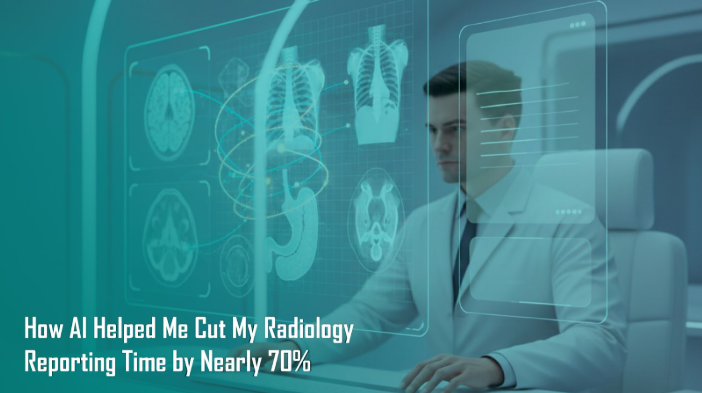
A focused radiologist utilizing a multi-monitor AI workstation, highlighting seamless integration for efficient diagnosis and reporting.

Final Reflection
Radiology has always been about interpreting what the patient cannot say. Over time, administrative burden, fragmented systems, and disconnected tools have started to drown out that purpose. What modern AI has done is quietly restore it.
With platforms such as RadpicsAI, AI-Powered PACS Systems, and advanced MedPACS environments for CT reporting and X-ray reporting, the radiologist no longer has to fight the software to reach the diagnosis. Everything from DICOM compression to DICOM viewing, from DICOM analysis tools to DICOM printing, now works in the background as part of a single intelligent workflow.
These are not just technical upgrades - they are radiology solutions that give clinicians back what matters most: clarity, speed, and cognitive space.
AI has not changed my role as a radiologist. I still interpret, decide, and take responsibility for every report. What has changed is how much of my time is spent fighting inefficient systems versus thinking clinically. With AI-driven MedPACS, integrated DICOM workflows, and platforms like RadpicsAI handling the repetitive layers of imaging, reporting, and data movement, my attention stays where it belongs - on the patient.
What AI gave me back was not just time, but focus, confidence, and the ability to practise radiology at the level it was always meant to be practised.
For me, that is the true value of AI in radiology.
Frequently Asked Questions
How does AI reduce radiology reporting time?
AI reduces radiology reporting time by automating measurements, structuring reports, prioritizing scans, and integrating seamlessly with PACS and imaging workflows.
Is AI radiology software safe for clinical use?
Yes. Modern AI radiology software is clinically validated and designed to support radiologists by improving efficiency while keeping final diagnostic decisions with clinicians.
Can AI integrate with existing PACS systems?
Most advanced AI radiology platforms are built for PACS integration, enabling seamless workflows without disrupting existing clinical systems.