


India's healthcare landscape is evolving rapidly. From large multi-specialty hospitals to independent diagnostic centers, imaging volumes are growing year after year. At the same time, radiology departments are expected to deliver faster reports, maintain diagnostic accuracy, and manage increasing workloads with limited resources.
Despite advances in medical imaging technology, many healthcare facilities continue to struggle with fragmented workflows. Patient information resides in one system, images are stored in another, and reporting is often handled separately. This lack of connectivity creates inefficiencies that slow down reporting and increase the risk of errors.
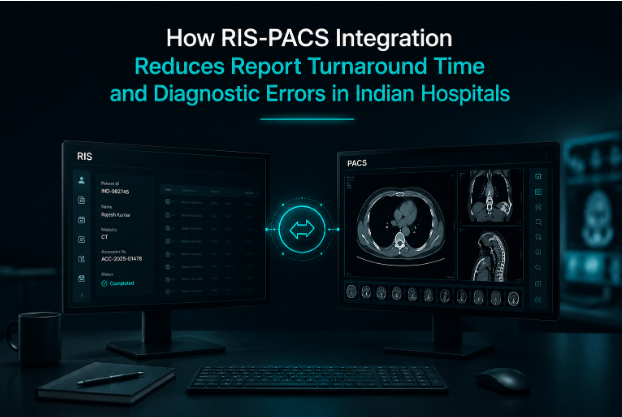
This is where RIS-PACS integration becomes essential.
By connecting patient data, imaging studies, reporting workflows, and communication channels into a unified ecosystem, integrated platforms like RadpicsAI help healthcare providers streamline operations, reduce turnaround times, and improve the overall quality of patient care.
The Hidden Cost of Disconnected Radiology Workflows
Many hospitals and imaging centers still operate using multiple standalone systems. A typical workflow often looks like this:
- Patient registration takes place in the Hospital Information System (HIS) or RIS.
- Imaging studies are stored in PACS.
- Radiologists access another platform for reporting.
- Reports are manually shared with clinicians or patients.
At first glance, this may seem manageable. However, every manual step introduces delays and opportunities for error.
Common challenges include:
- Duplicate patient data entry
- Incorrect patient demographics
- Mismatched studies
- Delayed report delivery
- Difficulty accessing prior examinations
- Communication gaps between departments
As patient volumes increase, these inefficiencies become even more significant.
Understanding RIS and PACS
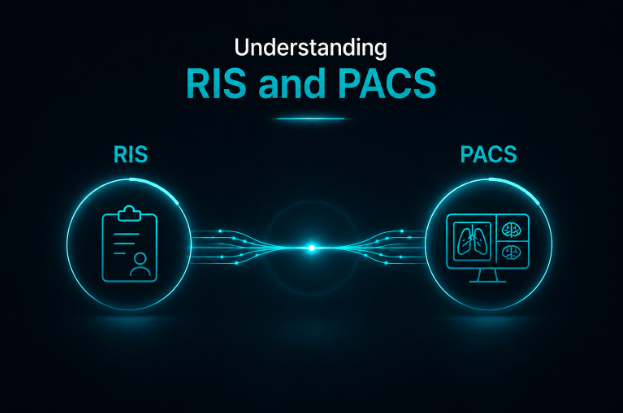
Before discussing integration, it's important to understand the individual roles of RIS and PACS.
Radiology Information System (RIS)
RIS serves as the operational backbone of a radiology department.
- Patient registration
- Appointment scheduling
- Examination tracking
- Worklists
- Report management
- Billing and administrative workflows
Picture Archiving and Communication System (PACS)
PACS is responsible for storing, retrieving, viewing, and sharing medical images.
It enables radiologists to access studies from modalities such as:
- CT
- MRI
- Ultrasound
- X-Ray
- Mammography
While both systems are valuable independently, their true potential is realized when they work together seamlessly.
What Happens When RIS and PACS Are Fully Integrated?
RIS-PACS integration creates a continuous flow of information throughout the radiology journey.
When a patient is registered:
- Information is automatically synchronized.
- Imaging studies are linked to patient records.
- Worklists are updated in real time.
- Reports are generated within the same workflow.
- Images and reports remain connected throughout the process.
The result is a faster, smarter, and more reliable radiology operation.
How RIS-PACS Integration Reduces Report Turnaround Time
1. Automated Data Flow Eliminates Manual Processes
One of the biggest causes of reporting delays is manual data entry.
Without integration, staff often need to enter patient information multiple times across different systems.
Integrated workflows eliminate this duplication.
Patient demographics, examination details, and study information automatically flow between systems, reducing administrative workload and accelerating case processing.
2. Radiologists Receive Complete Information Instantly
Radiologists frequently need access to:
- Patient history
- Previous examinations
- Clinical indications
- Current imaging studies
In disconnected environments, gathering this information can take several minutes per case.
Integrated systems ensure everything is available within a single interface, enabling radiologists to begin interpretation immediately.
3. Faster Access to Prior Studies
Comparing current and historical examinations is a critical part of radiology.
RIS-PACS integration enables automatic retrieval of prior studies, allowing radiologists to evaluate disease progression without manually searching archives.
This not only saves time but also improves diagnostic confidence.
4. Streamlined Reporting Workflows
When image viewing and reporting are integrated, radiologists can move seamlessly from interpretation to report generation.
There is no need to switch applications or manually transfer information.
This significantly improves reporting efficiency and turnaround times.
How RIS-PACS Integration Reduces Diagnostic Errors
While speed is important, accuracy remains the foundation of quality healthcare.
Integrated workflows help reduce several common sources of error.
Improved Patient Identification
Patient information is automatically synchronized across systems, reducing the risk of mismatched studies and incorrect report assignments.
Consistent Data Across Departments
Everyone-from technicians to radiologists and referring physicians-works from the same dataset.
This minimizes communication errors and inconsistencies.
Reduced Manual Entry Mistakes
The fewer times information needs to be entered manually, the lower the risk of typographical and administrative errors.
Better Study Tracking
Integrated systems provide complete visibility into every stage of the radiology workflow, ensuring studies do not get lost, delayed, or overlooked.
Why This Matters for Indian Hospitals
Indian healthcare facilities face unique challenges:
- Rapidly growing patient volumes
- Increasing imaging demand
- Shortage of skilled radiologists
- Pressure to reduce report turnaround times
- Expansion of multi-location diagnostic networks
In such environments, operational efficiency becomes a necessity rather than a luxury.
A delay in reporting can affect:
- Emergency care
- Treatment planning
- Surgical decisions
- Patient satisfaction
By eliminating workflow bottlenecks, RIS-PACS integration helps hospitals meet these growing demands more effectively.
How RadpicsAI Brings RIS and PACS Together
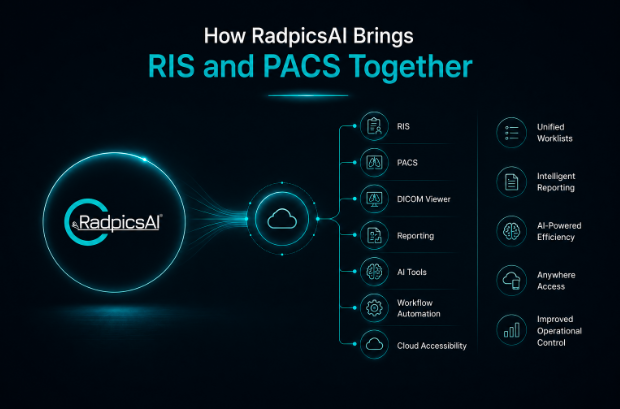
RadpicsAI goes beyond traditional RIS-PACS integration by creating a fully connected radiology ecosystem.
Rather than forcing radiologists to work across multiple disconnected platforms, RadpicsAI combines:
- RIS (MedCARE™)
- PACS (MedPACS™)
- DICOM Viewer (MedVIEWER™)
- Reporting (Reporting Co-Pilot)
- AI Tools
- Workflow Automation
- Cloud Accessibility
within a single unified solution.
Unified Worklists
Radiologists can view, prioritize, and manage cases from one centralized dashboard.
Intelligent Reporting
Integrated reporting tools eliminate unnecessary workflow steps and accelerate report generation.
AI-Powered Efficiency
Advanced AI capabilities assist radiologists by reducing repetitive tasks and improving productivity.
Anywhere Access
Secure cloud-based accessibility enables faster collaboration across hospitals, imaging centers, and remote reporting teams.
Improved Operational Control
Administrators gain better visibility into workloads, reporting performance, and department productivity.
Real-World Impact of Integration
Hospitals implementing integrated RIS-PACS workflows often experience:
- Faster report turnaround times
- Reduced administrative burden
- Fewer patient identification errors
- Improved radiologist productivity
- Better clinician satisfaction
- Enhanced patient experience
These improvements directly contribute to more efficient healthcare delivery.
The Future of Radiology is Connected
Radiology is rapidly moving toward intelligent, integrated ecosystems powered by automation and artificial intelligence.
The next generation of workflows will include:
- AI-assisted reporting
- Automated case prioritization
- Smart worklist management
- Predictive workflow optimization
- Cloud-native collaboration
Healthcare providers that adopt integrated solutions today will be better equipped to meet tomorrow's demands.
Conclusion
In modern healthcare, every minute matters.
Disconnected systems slow down reporting, increase administrative complexity, and create opportunities for errors.
RIS-PACS integration solves these challenges by connecting patient information, imaging studies, reporting workflows, and clinical communication into a single seamless process.
With its integrated RIS, PACS, reporting environment, AI-powered tools, and workflow automation capabilities, RadpicsAI helps hospitals and diagnostic centers reduce turnaround times, improve accuracy, and deliver better patient outcomes.
As India's healthcare ecosystem continues to evolve, integrated radiology platforms will play a critical role in building faster, smarter, and more efficient diagnostic services.
FAQs
Frequently Asked Questions
What is RIS-PACS integration?
RIS-PACS integration connects patient management, imaging, and reporting systems into a unified workflow.
How does RIS-PACS integration reduce report turnaround time?
By automating data flow, reducing manual tasks, and providing instant access to studies and patient information.
Can RIS-PACS integration reduce reporting errors?
Yes. It minimizes duplicate data entry, improves patient identification, and ensures information consistency.
Why is RIS-PACS integration important for Indian hospitals?
It helps manage high patient volumes, improves efficiency, and supports faster clinical decision-making.
How does RadpicsAI support integrated radiology workflows?
RadpicsAI combines RIS, PACS, reporting, AI tools, workflow automation, and cloud accessibility into a single platform, creating a seamless radiology ecosystem.