


Radiology today is no longer a standalone function within a hospital. It is deeply connected to patient records, clinical decisions, and overall care delivery. As imaging volumes increase and expectations for faster diagnostics grow, disconnected systems can quickly become a bottleneck.
This is where the integration of HIS (Hospital Information System), RIS (Radiology Information System), and PACS (Picture Archiving and Communication System) becomes essential. When these systems work together seamlessly, they create a unified workflow that improves efficiency, reduces errors, and enhances patient care.
Platforms like RadpicsAI are designed around this idea of connected healthcare, where imaging, reporting, and patient data are part of one continuous ecosystem rather than isolated processes.
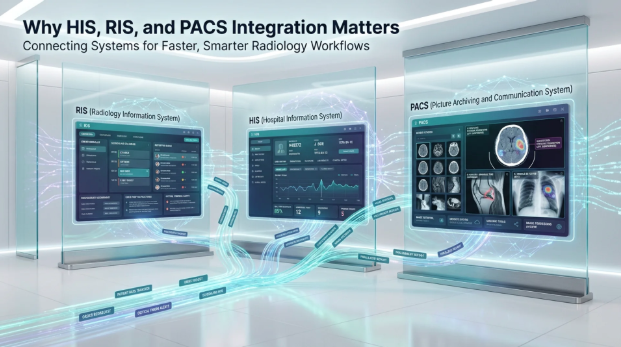
Understanding the Role of Each System
To understand why integration matters, it is important to look at what each system does individually.
HIS manages overall hospital operations, including patient registration, billing, and medical records. RIS focuses specifically on radiology workflows such as scheduling, case tracking, and report management. PACS is responsible for storing, retrieving, and displaying medical images like X-rays, CT scans, and MRIs.
Individually, these systems serve their purpose well. However, when they operate in isolation, inefficiencies begin to surface. Data duplication, delays in reporting, and gaps in communication can directly impact both workflow efficiency and patient outcomes.
The Problem with Disconnected Workflows
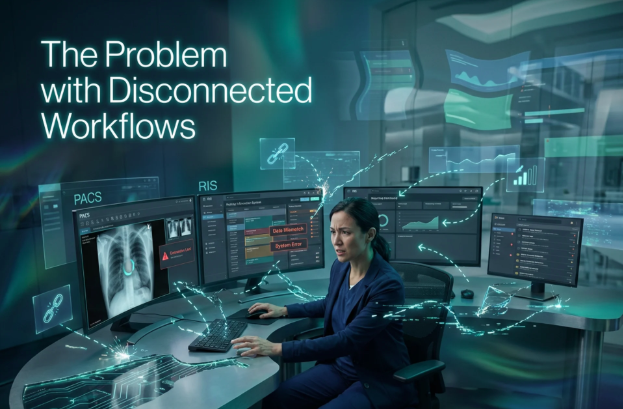
In many healthcare environments, these systems are implemented at different times and often from different vendors. This leads to fragmented workflows that rely heavily on manual intervention.
For instance, a patient registered in the HIS may need to be manually entered into the RIS before imaging can begin. After the scan, images stored in PACS may not automatically link to the patient's report or clinical history. These small gaps create delays and increase the chances of errors.
Over time, such inefficiencies can significantly slow down operations and add pressure on already overburdened radiology teams.
Why Fragmentation Hurts More Than It Looks
Radiology doesn't fail because the tools aren't good enough. It fails when those tools don't talk to each other.
In most hospitals, a study might be scheduled in one system, taken in another, and reported in a third — with manual steps required at every handover. Patient data gets typed in more than once. Reports get exported, uploaded, or shared over email or WhatsApp. Small delays pile up, and what looks like minor friction in one case becomes a real bottleneck at scale.
You don't always notice this in a single patient encounter. You see it when you look at the bigger picture.
Radiology is, by nature, a high-throughput function. Dozens — sometimes hundreds — of studies move through the system every day. In such an environment, even small inefficiencies stretch turnaround times, grow backlogs, and put radiologists under constant pressure. In time-sensitive situations like stroke, trauma, or acute abdomen, those gaps can have real consequences for patients.
The problem runs deeper than speed. Without integration, hospitals rely on workarounds — manually exporting PDFs, re-keying data, or sharing findings over messaging apps. Every extra step adds a chance for delay or miscommunication. Inconsistencies make it hard to run a smooth, predictable operation.This is what makes unified workflows not just a technical upgrade, but a fundamental fix at the root of how radiology operates.
What True Integration Looks Like
Integration is more than just connecting systems—it is about creating a seamless flow of information across the entire diagnostic journey.
In an integrated setup, patient data flows automatically from registration to imaging and reporting. Imaging studies are directly linked to patient records, and reports are generated without duplication of effort. Clinicians can access all relevant information from a single interface, eliminating the need to switch between systems. This level of continuity is what enables efficient, reliable, and scalable radiology workflows.
Key Benefits of HIS, RIS, and PACS Integration
Faster Turnaround Times Integration eliminates repeated data entry and manual coordination, speeding up the entire workflow—from patient registration to report delivery. Radiologists access information instantly, enabling faster reporting, especially critical in emergencies.
Reduced Errors and Better Accuracy By capturing data once and sharing it across systems, integration minimizes manual errors. Radiologists get complete clinical context, leading to more accurate diagnoses.
Improved Collaboration Integrated systems enable seamless access to imaging and clinical data across departments, improving communication, faster decisions, and coordinated patient care.
Enhanced Patient Experience Patients benefit from quicker appointments, faster reports, and fewer repeat tests—resulting in smoother, more reliable care.
Scalability Integration supports multi-location operations by enabling centralized access and consistent workflows, making it easier for healthcare providers to scale efficiently.
AI Enablement Connected systems allow AI to analyze imaging with clinical data, improving prioritization, insights, and automation.
Operational Efficiency and Cost Savings Automation reduces administrative work, boosts productivity, and optimizes resources—leading to long-term cost savings.
Moving Toward a Unified Healthcare Ecosystem
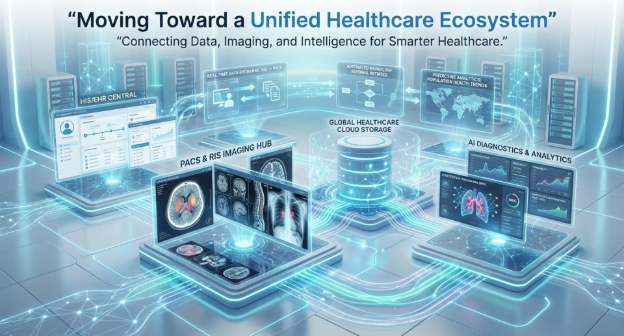
The future of healthcare lies in connected systems that work together seamlessly. Radiology, being highly data-driven, benefits significantly from this approach.
Solutions like RadpicsAI bring together imaging, reporting, patient management, and AI into a unified platform. This reduces complexity and allows healthcare providers to focus on delivering better care.
Frequently Asked Questions
What is HIS, RIS, and PACS integration?
It refers to connecting hospital systems so that patient data, imaging studies, and reports flow seamlessly across platforms without manual intervention.
Why is integration important in radiology workflows?
Integration eliminates data duplication, reduces errors, improves turnaround time, and ensures better coordination between departments.
Does integration improve diagnostic accuracy?
Yes, because radiologists have access to complete patient information, including clinical history and prior studies, which supports more informed decisions.
Is integration expensive for hospitals?
While there may be an initial investment, integrated systems reduce long-term operational costs by improving efficiency and minimizing errors.
How does integration support AI in radiology?
AI requires structured and connected data to function effectively. Integration ensures that imaging and clinical data are available for accurate AI analysis.
Can small hospitals benefit from integrated systems?
Yes, even smaller healthcare providers can benefit by improving efficiency, reducing workload, and delivering better patient care through streamlined workflows.