


When people talk about AI in radiology, they almost always talk about the diagnosis part. The AI that reads a chest X-ray. The algorithm that flags a nodule on CT. That part gets attention because it is visible - you can point to a finding and say, the AI caught that.
But there is another layer of technology doing just as much heavy lifting in the background. It does not have a dramatic moment of detection. It does not flag anything. It just makes sure that the right study reaches the right radiologist at the right time, with everything ready so they can focus entirely on diagnosis.
It is called workflow orchestration. And in 2026, for departments under pressure, it might be the most valuable tool they are not using.
What Is Workflow Orchestration, Exactly?
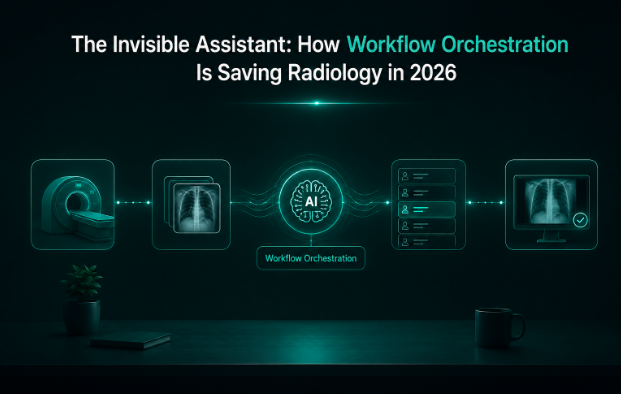
Think about what happens between the moment a patient's scan is completed and the moment a radiologist opens it.
In most departments, that journey involves multiple handoffs. The scan arrives. Someone assigns it to a worklist. A radiologist picks it up, realises they need a prior study, opens a separate system to find it, loads it manually, adjusts the image layout, and then - finally - starts reading. In a busy department, that sequence plays out dozens of times a day. Every friction point adds up.
Workflow orchestration automates that entire journey. It decides which study goes to which radiologist, in what order, based on urgency, subspecialty, and current workload. It fetches prior studies automatically. It applies hanging protocols so the images are in the right layout before the radiologist clicks open. It tracks whether studies are being completed within their target turnaround times and escalates if something is at risk of being delayed.
The radiologist just reads. Everything else is handled.
Why Does This Matter Right Now?
Indian radiology departments are being squeezed from multiple directions at once.
Imaging volumes are growing - more scans, more complexity, more subspecialty studies that need specialist review. The number of trained radiologists is not keeping pace. And the studies themselves are getting larger - a modern chest CT might have 600 images where ten years ago it had 60. More data, same shift hours, same number of people.
The result is what you would expect: delayed reports, radiologists burning out, and in some cases studies sitting in queues longer than they should. Workflow orchestration does not solve the radiologist shortage. But it closes the gap between the capacity that does exist and the output that capacity should be delivering.
What Does It Actually Do?
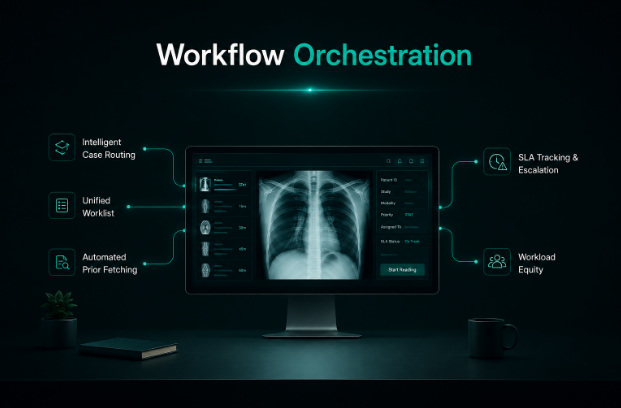
Intelligent Case Routing
Instead of radiologists manually picking cases from a generic queue - or, in some departments, quietly avoiding the complex ones - workflow orchestration assigns cases automatically. Urgent cases go to the radiologist with the right subspecialty and available capacity. Routine studies are batched efficiently. No favouritism, no bottlenecks, no cases slipping through because the queue looked long and nobody checked.
RadpicsAI's MedPACS includes automated case routing as part of the workflow engine. Studies are triaged and assigned from the moment they arrive.
A Unified Worklist
Radiologists at busy centres often work across multiple PACS systems , multiple hospital sites, and multiple teleradiology contracts - each with its own login, its own interface, its own worklist. Switching between them is exhausting and creates real opportunities for things to be missed.
Workflow orchestration pulls all of that into a single view. One screen. One login. Every pending study from every source, prioritised and ready.
Automated Prior Fetching
Comparison with prior studies is one of the most important - and most time-consuming - parts of reading radiology. Finding the right prior study, loading it, aligning it for comparison - that can take several minutes per study. Across 60 studies a day, that is a meaningful chunk of the shift.
Workflow orchestration handles prior fetching automatically. The right prior is loaded and waiting before the radiologist opens the current study. They spend far less time looking for it.
SLA Tracking and Escalation
Every study has a target turnaround time - 30 minutes for a STAT brain CT, 24 hours for a routine chest X-ray. Workflow orchestration tracks every study against those targets in real time and flags anything at risk before it actually breaches. Studies do not slip through because a queue backed up and nobody noticed.
Workload Equity
One radiologist reading 90 studies while another reads 30 is not just unfair - it is unsustainable. Workflow orchestration distributes studies equitably across the team, adjusting dynamically throughout the shift as radiologists log in and out.
What Does This Look Like in a Real Setting?
Consider a hypothetical teleradiology network covering 15 diagnostic centres across Maharashtra that receives 400 studies overnight. Before workflow orchestration, a coordinator manually sorted studies each morning - a slow, imperfect process where urgent cases sometimes waited too long and some radiologists were overloaded while others sat idle.
With RadpicsAI's workflow engine, all 400 studies are automatically triaged overnight. STAT cases are flagged for immediate attention. Subspecialty studies go to the right radiologist. Priors are pre-fetched. By the time the team logs in at 7am, their worklists are personalised, prioritised, and ready. The first report goes out within minutes of shift start.
That gap between capacity and output - that is what orchestration closes.
Is This Only for Large Hospitals?
No. Workflow orchestration scales in both directions.
For a large hospital network or teleradiology operation, it manages the complexity of routing thousands of studies across dozens of radiologists and multiple sites - all automatically. For a smaller diagnostic centre running 50 studies a day with one or two radiologists, it still eliminates the manual sorting and prior-fetching that eats into reading time.
The efficiency gains are proportional to the scale, but meaningful at every scale.
RadpicsAI's MedPACS is built to serve both ends of that spectrum with the same platform.
The Invisible Part
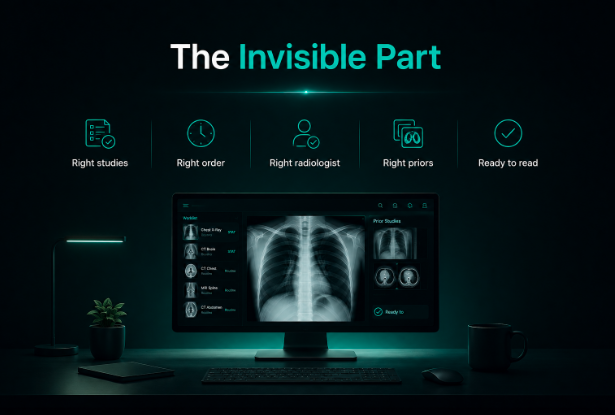
Here is the thing about workflow orchestration: when it is working well, you do not notice it.
You do not notice it because the studies are just there - in the right order, with the right priors loaded, assigned to the right radiologist. There is no friction. The radiologist opens their workstation and the next case is ready.
That invisibility is deliberate. The best workflow tools do not add complexity - they remove what was getting in the way before.
The Bottom Line
AI in radiology gets attention for diagnosis. But the capacity crisis in Indian radiology is not purely a diagnostic problem - it is also a workflow problem. Studies sitting in queues, priors fetched by hand, cases distributed by gut feel rather than data. These are inefficiencies that make the shortage worse than it needs to be.
Workflow orchestration fixes those inefficiencies. It is the invisible layer that makes everything else - the AI, the PACS, the teleradiology, the reporting - actually work at scale.
And in an environment under pressure, that makes it anything but invisible.
FAQs
Frequently Asked Questions
What is workflow orchestration in radiology?
It is a system that automatically manages every step between a scan being completed and a report being delivered - case assignment, prior fetching, worklist management, and SLA tracking - so radiologists can spend their time reading rather than administrating.
How is it different from a standard PACS worklist?
A standard worklist shows you pending studies. Workflow orchestration actively manages those studies - routing them intelligently, tracking turnaround times, pre-loading priors, and escalating when something is delayed.
Does RadpicsAI include workflow orchestration?
Yes. MedPACS includes intelligent case routing, automated prior fetching, unified worklist management, and SLA tracking as part of the core platform.
Can it work across multiple hospital sites?
Yes - this is one of its biggest advantages. It consolidates studies from multiple sites into a single prioritised worklist, which is particularly valuable for teleradiology operations covering several centres.
Will it change how radiologists work day to day?
It reduces friction - less manual sorting, less hunting for priors, less switching between systems. Most radiologists find their reading experience significantly smoother after adoption.
Is workflow orchestration only useful for large hospitals?
No. Even a small diagnostic centre benefits from automated case management and prior fetching. The efficiency gains are real at any scale.
How does it handle urgent or STAT cases?
Urgent studies are flagged automatically - by AI triage, by the modality, or by referring clinician input - and placed at the top of the right radiologist's worklist. SLA tracking ensures they do not get delayed.
How long does implementation take?
For RadpicsAI, workflow configuration is part of the standard onboarding process. Most centres have their routing logic and worklist rules set up within the first week.