


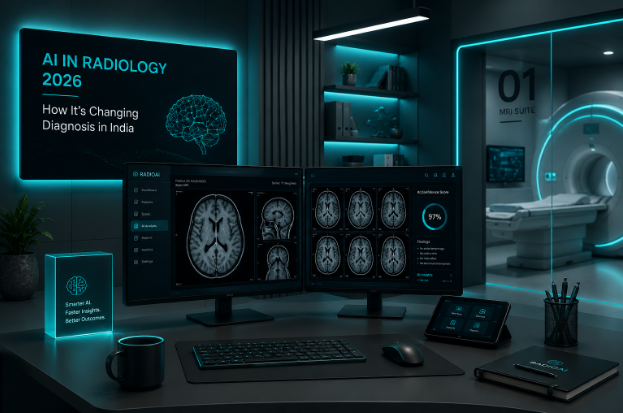
India has a growing healthcare challenge: there simply aren't enough radiologists to keep pace with the rising demand for medical imaging.
Every day, hospitals, diagnostic centres, and clinics across the country generate thousands of X-rays, CT scans, MRIs, ultrasounds, and other imaging studies. These scans are critical for diagnosing conditions ranging from fractures and infections to strokes, cancers, and heart diseases. However, the number of trained radiologists available to interpret these images remains limited.
Reports suggest that India has roughly one radiologist for every 100,000 people, creating a significant gap between demand and available expertise. This shortage is even more pronounced in Tier 2 and Tier 3 cities, rural regions, and underserved healthcare facilities where access to specialist doctors is limited.
The consequences are substantial. Radiologists often work under immense pressure, reviewing hundreds of scans each day. As imaging volumes continue to grow, reporting backlogs become common. Patients may wait hours—or even days—for critical diagnostic reports. In emergency situations, these delays can impact treatment decisions and patient outcomes. Overworked clinicians also face a higher risk of fatigue, which can increase the likelihood of missed findings or reporting inconsistencies.
This is where Artificial Intelligence (AI) is beginning to transform healthcare.
What AI Actually Does
When you get a chest X-ray today, AI can scan it in seconds and flag anything unusual — a shadow, a nodule, a fracture. It helps the doctor see faster and catch what might be easy to overlook after a long shift. Some AI systems can also prioritise urgent cases automatically, ensuring critical scans are reviewed first.
It can also write the first draft of a radiology report automatically, so the radiologist just reviews and approves instead of typing everything from scratch. That alone saves a huge amount of time.
Why This Matters for India Specifically
Most specialist radiologists are in big cities. A patient in a small town or village doesn't have easy access to one. With cloud-based platforms like RadpicsAI, a scan taken in a small clinic can be uploaded instantly, reviewed by AI, and then checked by a specialist sitting anywhere in the country. The patient gets their result the same day.
That's a genuine game-changer for rural healthcare.
Will AI Replace Radiologists?
No. Think of it like autocomplete on your phone — it helps you type faster, but you're still writing the message. AI handles the routine, repetitive part of reading scans. The radiologist handles the complex cases, the tricky calls, and the final sign-off. The two work together.
What's Happening Right Now
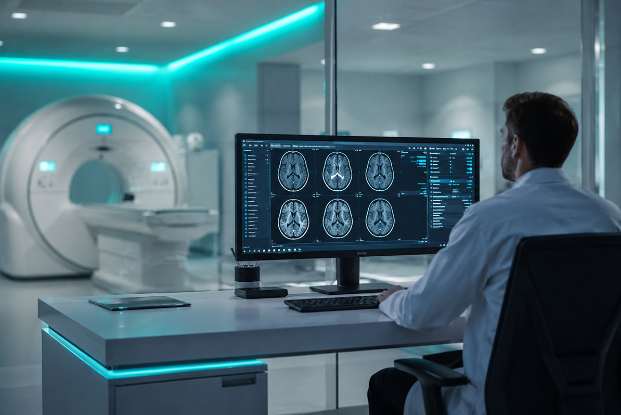
Platforms are already helping reduce report turnaround time by up to 40%, enabling radiologists to manage growing imaging volumes more efficiently. AI-assisted tools have shown strong performance in identifying findings such as pneumonia, fractures, lung nodules, and tumours — particularly when used alongside radiologists as a clinical support system rather than a replacement.
This collaboration helps diagnostic centres improve workflow efficiency, prioritize urgent cases faster, and handle more patients without proportionally increasing staffing requirements.
Challenges in AI Adoption for Radiology
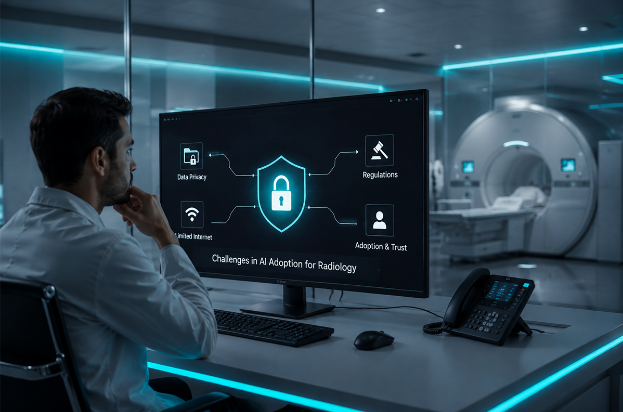
AI in radiology still faces important challenges, including data privacy concerns, limited internet infrastructure in some regions, doctor adoption and trust, and evolving healthcare regulations. While these hurdles remain, AI-assisted radiology continues to progress steadily across the healthcare industry.
The Bottom Line
AI in radiology isn't a future thing anymore. It's happening now, in Indian hospitals and diagnostic centres. It means faster reports, fewer missed findings, and better access for patients who previously had none.
Frequently Asked Questions
Is AI replacing radiologists in India?
No. AI assists radiologists — it reads scans faster and flags concerns, but a qualified doctor always reviews and gives the final report. Think of it as a smart assistant, not a replacement.
How does AI help patients in rural areas?
A scan taken at a small clinic can be uploaded to a cloud platform, reviewed by AI, and checked by a specialist remotely. Patients get faster results without travelling to a big city.
Is AI-powered radiology accurate?
For specific tasks like detecting pneumonia, fractures, or nodules, AI models have shown accuracy comparable to experienced radiologists. They are most effective when working alongside a doctor, not alone.
Which scans can AI read?
Most platforms today support X-rays, CT scans, MRIs, and ultrasounds. Some also handle mammography and retinal imaging.
Is my medical scan data safe on a cloud platform?
Reputable platforms use enterprise-grade encryption and strict access controls. Always check that the platform you use is compliant with data privacy regulations.
How fast does AI generate a radiology report?
AI can produce a preliminary report in seconds. The radiologist then reviews and finalises it — cutting total turnaround time by up to 40% compared to traditional workflows.
What is a cloud PACS and why does it matter?
PACS stands for Picture Archiving and Communication System — it stores and manages medical images. A cloud PACS means scans are stored online, accessible from anywhere, making teleradiology and remote reporting possible.
Can small diagnostic centres afford AI radiology tools?
Yes. Cloud-based platforms are generally subscription-based and scalable, meaning even a small centre can start without heavy upfront costs.