


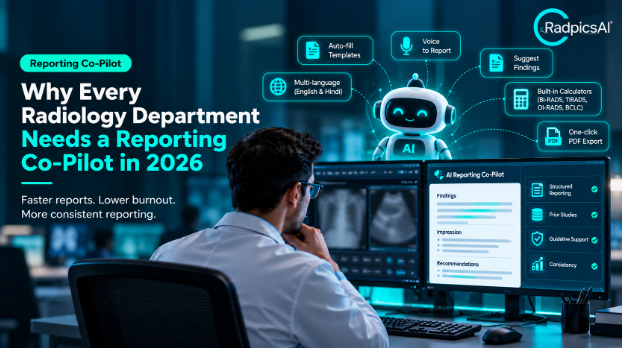
Scan volumes keep rising, but the number of radiologists is not keeping up. If your team is feeling that squeeze, a reporting co-pilot may be the fix you need. It is a smart assistant that sits inside your reporting screen and helps radiologists write accurate reports faster. At RadpicsAI, our Reporting Co-Pilot works hand in hand with MedPACS, MedVIEWER and MedCARE, so images, worklists and reports all live in one connected place. In this blog, we explain what a co-pilot is, why 2026 is the year to adopt one, and how to get started.
What Is a Radiology Reporting Co-Pilot?
Think of it like a helpful junior colleague who never gets tired. The radiologist is always in charge and makes every final decision. The co-pilot handles the boring, repetitive parts of reporting.
A good reporting co-pilot can:
- Fill in templates and scan measurements automatically
- Turn spoken words into a clean, structured report (voice to report)
- Suggest findings and wording for the radiologist to review
- Include standard scoring tools such as BI-RADS, TIRADS, OI-RADS and Barcelona (BCLC) calculators
- Export a print-ready PDF in one click
- Support more than one language, including English and Hindi
In short: it is not a robot doctor. It is a time-saver that lets doctors focus on reading images, not typing.
7 Reasons Your Radiology Department Needs One in 2026
1. Scan volumes are growing faster than teams
More people are getting CT, MRI, ultrasound and X-ray scans every year. Hiring more radiologists takes years. A co-pilot helps your current team handle more cases without working longer hours.
2. Faster reports mean faster treatment
Patients and referring doctors are waiting for results. When reports go out sooner, treatment can start sooner. A co-pilot cuts typing and template work, which directly shortens radiology report turnaround time.
3. It helps fight radiologist burnout
Long hours of dictating, typing and fixing formatting wear people down. When the co-pilot handles routine work, radiologists get time and energy back for complex cases.
4. Fewer errors, more consistent reports
Tired eyes miss small details, and every doctor words things a little differently. Structured reporting gives every report the same clear layout. Built-in calculators also reduce manual scoring mistakes.
5. Referring doctors get clearer answers
A report that is easy to read is easier to act on. Standard layouts mean clinicians can find the impression and next steps in seconds.
6. It supports teleradiology and multi-centre work
If your radiologists report from different sites or from home, a cloud-based tool keeps everyone on the same templates and standards. Reports look the same no matter who writes them or where.
7. Patients and hospitals expect modern tools
Hospitals now compare technology before choosing a diagnostic partner. Patients also expect quick, clear reports. A reporting co-pilot shows that your department is ready for the future.
| Traditional Reporting | With a Reporting Co-Pilot | |
|---|---|---|
| Typing effort | High, mostly manual | Low, with voice and auto-fill |
| Report layout | Different for each doctor | Standard and structured |
| Scoring (BI-RADS, TIRADS) | Manual | Built-in calculators |
| Turnaround time | Slow during peak hours | Faster, even on busy days |
| Doctors workload | Heavy | Lighter and more focused |
Will AI Replace Radiologists? No.
This is the most common worry, so lets answer it clearly. A co-pilot assists; it does not replace. The radiologist reviews, edits and signs off on every report. AI handles the routine; the doctor handles the judgment. This is also why a human-in-the-loop design matters when you choose a tool.
What to Look for Before You Choose a Co-Pilot
Not every tool is equal. Ask these questions:
- Does it connect with your PACS and viewer? A co-pilot that works inside your existing system saves clicks. See how MedPACS and MedVIEWER fit together.
- Is it secure? Look for end-to-end encryption, role-based access and audit logs. Check for HIPAA assessment and support for DICOM, HL7 v2 and HL7 FHIR R4 standards.
- Does it speak your language? Multi-language support matters in diverse regions.
- Can it grow with you? Cloud, on-premise and hybrid options give you room to scale.
- Is the radiologist always in control? Every AI suggestion should be easy to accept, edit or reject.
How to Get Started in 4 Simple Steps
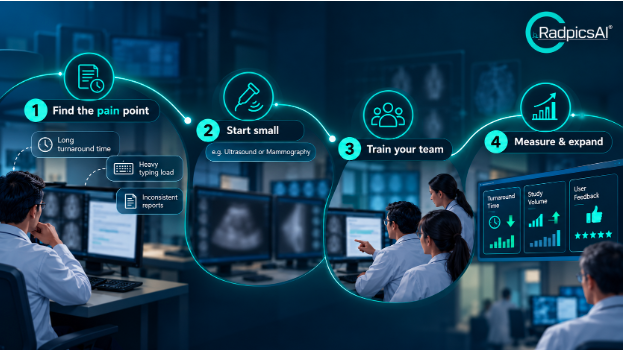
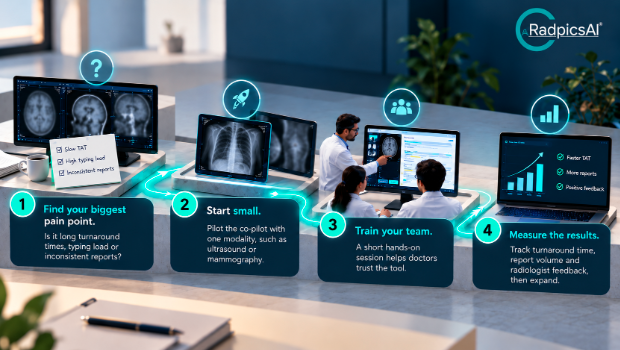
1. Find your biggest pain point.
Is it long turnaround times, typing load or inconsistent reports?
2. Start small.
Pilot the co-pilot with one modality, such as ultrasound or mammography.
3. Train your team.
A short hands-on session helps doctors trust the tool.
4. Measure the results.
Track turnaround time, report volume and radiologist feedback, then expand.
Frequently Asked Questions
What is a radiology reporting co-pilot?
It is an AI-assisted tool that helps radiologists create reports faster using templates, voice dictation, smart suggestions and built-in calculators. The radiologist always reviews and approves the final report.
Can a reporting co-pilot replace a radiologist?
No. It supports the radiologist by handling repetitive tasks. Clinical decisions and sign-off always stay with the doctor.
Does AI radiology reporting really reduce turnaround time?
Yes, in most cases. Auto-filled templates, voice-to-report and one-click export remove many manual steps, so reports are ready sooner.
Is it suitable for small diagnostic centres?
Yes. Small centres often benefit the most because a co-pilot lets a small team handle more scans without extra staff.
Is patient data safe?
Choose a platform with encryption, access controls, audit trails and independent HIPAA assessment. RadpicsAI is built with these safeguards.
Final Thoughts
In 2026, a reporting co-pilot is quickly becoming a basic need for radiology departments, not a luxury. It saves time, reduces errors, supports tired teams and helps patients get answers sooner.