


Introduction: The Big Question Everyone Is Asking
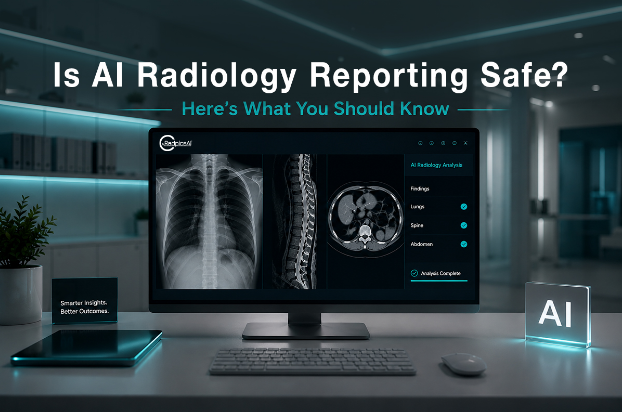
If you've recently had an MRI, CT scan, or X-ray, there's a good chance AI played some role in analyzing your medical images. For many people, that can sound a little concerning.
"Can a machine really read my scan?" , "What if it misses something?"
These are valid questions. The good news is that AI isn't replacing radiologists—it's helping them. By quickly analyzing images, flagging potential abnormalities, and prioritizing urgent cases, AI helps doctors work faster and more efficiently. Platforms like RadpicsAI use AI as a support tool, while trained radiologists remain in control of the final diagnosis. When used responsibly, AI can improve reporting speed, enhance accuracy, and provide an extra layer of confidence in medical imaging.
Spoiler alert: when used responsibly and under expert supervision, AI radiology reporting is not only safe—it can improve efficiency, support consistency, and even help detect subtle abnormalities that might otherwise go unnoticed. The future of radiology isn't humans versus AI; it's humans and AI working together to deliver better patient care.
What Is AI Radiology Reporting, Anyway?
Let's keep it simple. When you get a scan done at a hospital or diagnostic centre, a specialist called a radiologist looks at your images and writes a report — describing what they see, any abnormalities, and what it might mean for your health.
AI radiology reporting means that a smart software tool helps with that process. It might:
- Highlight areas in the image that look unusual
- Measure the size of a lesion or nodule automatically
- Generate a draft report that the radiologist then reviews and approves
- Flag urgent findings so nothing gets lost in a busy queue
Think of it less like "AI replacing the doctor" and more like "AI acting as an incredibly fast, tireless assistant."
Is AI Radiology Reporting Actually Safe?
Yes — with the right safeguards in place.
Here's the honest truth: AI is not infallible. No technology is. But neither are humans. Studies have consistently shown that radiologists can miss abnormalities due to fatigue, workload, or perceptual error — one reason AI-assisted review is gaining traction. AI doesn't experience fatigue or inconsistency. It analyzes every pixel with the same level of precision and attention—whether it's 2 AM or 10 AM—delivering reliable, consistent performance around the clock.
That said, AI radiology tools are designed to assist, not replace. A radiologist always has the final say. The AI flags, the human decides. This "human-in-the-loop" approach is what makes modern AI reporting tools genuinely safe for patients.
The Role of PACS-Integrated Radiology AI
One of the biggest game-changers in safe AI reporting is PACS-Integrated Radiology AI — and this is where things get really interesting.
PACS stands for Picture Archiving and Communication System. It's essentially the digital storage and retrieval system that hospitals use to manage all their medical images. When AI is directly integrated into this system, it means:
- No extra steps for the radiologist — AI insights appear right inside their existing workflow
- Faster detection — the AI analyses images the moment they're uploaded, before the radiologist even opens the file
- Consistent accuracy — the same AI model reviews every case, reducing human inconsistency
- Full traceability — every AI finding is logged, reviewed, and tied to the final report
RadpicsAI's MedPACS™ solution is built exactly on this principle. It seamlessly combines PACS, AI, and workflow automation in one place — so hospitals and diagnostic centres aren't juggling multiple disconnected systems. The result? Safer, smarter, faster diagnostics.
Why Faster Radiology Reporting Time Matters
Here's something that doesn't get talked about enough: delayed reports are a patient safety issue.
If a radiologist is buried under hundreds of scans, urgent findings can sit in the queue for hours — sometimes longer. In emergency cases, every minute matters.
AI dramatically cuts down radiology reporting time. RadpicsAI, for instance, is designed to reduce reporting turnaround times by up to 40%. That's not just a nice efficiency metric — it means:
- Cancer detected and communicated sooner
- Emergency findings flagged before they escalate
- Doctors getting the information they need to act faster
- Patients spending less time anxiously waiting
Faster reporting = safer outcomes. It really is that straightforward.
Are AI Reporting Tools Regulated?
Yes — reputable AI reporting tools go through rigorous testing and regulatory evaluation before being used in clinical settings. In India and globally, medical AI software must meet standards for accuracy, safety, and clinical validation.
Here's what you should look for when asking whether an AI reporting tool is safe:
- Clinical validation — Has it been tested on real patient data across diverse populations?
- Radiologist oversight — Is a qualified human always reviewing the AI output?
- Audit trail — Is every AI decision logged and reviewable?
- Integration quality — Does it work seamlessly within the hospital's existing systems without creating data silos?
- Data security — Is patient data encrypted and stored safely?
RadpicsAI checks all of these boxes. With enterprise-grade security, seamless HIS/RIS/EMR integration, and AI tools designed to support (not override) clinical judgment, it's built with patient safety at its core.
Real Concerns Worth Acknowledging
Being honest here matters. There are legitimate concerns about AI in radiology:
- Bias in training data: If an AI was trained mostly on images from one population, it may be less accurate for others. Good platforms continually update and diversify their models.
- Over-reliance: If radiologists start rubber-stamping AI reports without proper review, errors can slip through. Training and accountability structures are essential.
- Rare or unusual cases: AI is great at recognising common patterns. Unusual presentations may still require extra human attention.
The answer to all of these isn't to avoid AI — it's to use it responsibly, with the right checks in place. Which is exactly what platforms like RadpicsAI are built to do.
How RadpicsAI Approaches Safe AI Reporting
RadpicsAI was built with one founding principle: make diagnostics smarter without cutting corners on safety or accuracy.
Here's what sets it apart:
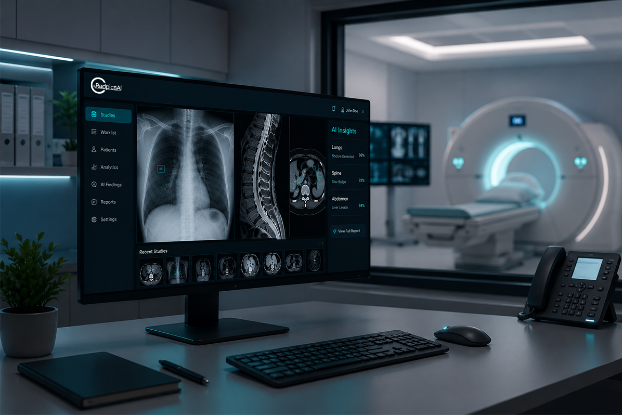
- MedPACS™ integrates PACS, appointment management, case allocation, and AI-assisted reporting in one seamless platform
- MedVIEWER™ gives radiologists a powerful web and mobile-based viewer for CT, MRI, X-ray, and Ultrasound — with AI-assisted insights baked in
- AI-Enabled Calculators (BI-RADS, TIRADS, OI-RADS, Barcelona) provide standardised, evidence-based risk scoring that reduces subjectivity
- Automated report generation reduces manual workload while keeping the radiologist firmly in control
- 3D Imaging Engine helps with complex CT and MRI interpretation using volumetric reconstruction
And all of it works within a secure, scalable cloud infrastructure — meaning whether you're a single diagnostic centre or a multi-location hospital network, the same level of safety and accuracy applies.
The Bottom Line
AI radiology reporting is safe — when it's implemented thoughtfully, regulated properly, and used as a tool in the hands of skilled radiologists, not as a replacement for them.
The combination of PACS-Integrated Radiology AI, dramatically reduced radiology reporting time, and clinically validated AI reporting tools is already saving lives. Not in some distant future - right now, in hospitals and diagnostic centres that have made the switch.
If you're a healthcare provider wondering whether to make the leap, the better question to ask is: can you afford not to?
Frequently Asked Questions
Does RadpicsAI replace radiologists?
Absolutely not. RadpicsAI is designed to support radiologists, not replace them. The AI flags findings, measures structures, and generates draft reports - but a qualified radiologist always reviews and approves the final report. Think of it as giving your radiologist a very smart assistant that never gets tired.
How does RadpicsAI keep my medical data safe?
RadpicsAI uses encrypted storage, secure access controls, and audit logging. The platform is built for compliance with healthcare data privacy standards, and every piece of patient information is stored and accessed through secure, auditable channels.
Can RadpicsAI work with the PACS system my hospital already uses?
Yes. RadpicsAI's MedPACS™ is designed for seamless integration with existing PACS, RIS, HIS, and EMR systems. You don't need to rip out your current setup - RadpicsAI plugs in and enhances what you already have. The PACS-Integrated Radiology AI approach means minimal disruption and maximum benefit.
How much faster is radiology reporting time with RadpicsAI?
RadpicsAI's workflow automation and AI-assisted tools are designed to reduce reporting turnaround times by up to 40%. For urgent or emergency cases, the AI prioritises and flags critical findings immediately, ensuring that time-sensitive diagnoses are never stuck in a queue.
Is RadpicsAI suitable for smaller diagnostic centres, or only large hospitals?
RadpicsAI is built to scale — it serves hospitals, diagnostic centres, insurers, and remote reporting setups alike. Whether you're a standalone clinic or a multi-branch network, the platform adapts to your size and workflow. Smaller centres especially benefit from the efficiency gains, as it allows them to handle more cases with the same team, without compromising on quality or safety.