


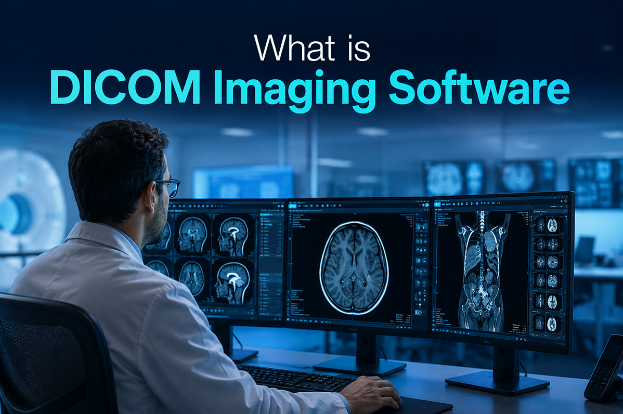
If you have ever had an X-ray, CT scan, MRI, or ultrasound, your medical images were almost certainly stored, shared, and viewed using something called DICOM software. The name sounds technical — but the concept is actually very simple. And understanding it can help you make better sense of your own healthcare.
In this guide, we break it all down in plain, everyday language - no medical degree required.
So, What Exactly is DICOM?
DICOM stands for Digital Imaging and Communications in Medicine. Think of it as a universal language that all medical imaging machines speak. Whether a CT scanner was made in Germany, an MRI machine in Japan, or an X-ray device in India, DICOM ensures that the images they produce can be opened and read by any doctor, anywhere in the world.
Before DICOM existed, hospitals used different formats for different machines. It was like having a document saved in a format that only one specific app could open. DICOM solved that problem once and for all by creating a single, globally agreed-upon standard for medical imaging.
Even as healthcare moves to the cloud and AI-powered diagnostics become more common, DICOM remains the universal standard that keeps imaging systems connected, enabling seamless image sharing, faster collaboration, and more efficient patient care across hospitals and healthcare networks worldwide.
What Does DICOM Imaging Software Actually Do?
DICOM software is often used alongside PACS (Picture Archiving and Communication Systems), which help hospitals store and organize imaging data at scale. Here is what it allows them to do:
- View scans in great detail — zoom in, rotate, and adjust brightness to examine every layer
- Create 3D models — turn a series of flat scan slices into a full three-dimensional image of organs or bones
- Make precise measurements — calculate the exact size of a tumour, fracture, or cyst
- Compare old and new scans — track how a condition has changed over time
- Share images instantly — send scans to a specialist across the city or country in seconds
- Store everything securely — keep years of patient imaging history in one safe, accessible place
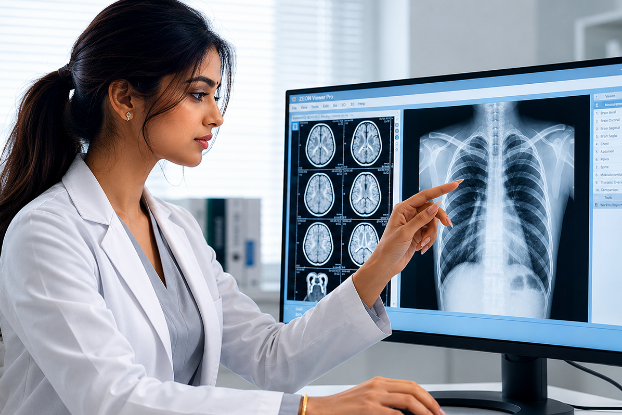
Why Does This Matter for Patients?
Better software means better care. Here is the real-world difference it makes:
Faster Diagnosis. When a radiologist in a small town can send your scan to a senior specialist in a metro hospital within minutes, you get accurate answers faster — without having to travel. In critical cases, that speed can be life-saving.
No More Lost Films. Remember carrying X-ray films in big brown envelopes? DICOM software replaces all of that. Your scans are stored digitally, securely, and can be accessed whenever needed — even years later.
Easy Second Opinions. If you want another doctor to review your scan, they no longer need to be in the same room. With cloud-based DICOM software, your images can be shared with any specialist instantly and securely.
AI-Assisted Accuracy. Modern DICOM platforms use artificial intelligence to assist radiologists — automatically flagging subtle abnormalities, reducing the chance of human error, and raising the overall standard of diagnostic care.
How RadpicsAI Makes DICOM Work Better for Everyone
At RadpicsAI, we have built a cloud-based DICOM imaging platform designed to make advanced radiology accessible — not just for large city hospitals, but for diagnostic centres and clinics across India and beyond.
Our MedVIEWER is a zero-footprint DICOM viewer, meaning it runs directly in your web browser with zero downloads or installation needed. Whether you are a radiologist at a large hospital or a doctor at a rural health centre, you get the same powerful imaging tools.
Here is what sets RadpicsAI apart:
- AI-Powered Insights — The platform actively assists in interpretation, helping detect potential issues automatically
- 3D and MPR Visualisation — Doctors can explore anatomy in three dimensions, making complex cases clearer
- Works on Any Device — Desktop, tablet, or smartphone — the experience is seamless everywhere
- Fully Integrated — Connects with appointment systems, electronic medical records (EMR), and video consultations
- Bank-Grade Security — All patient data and images are encrypted with enterprise-level protection
A Real-Life Example
Imagine a patient in a small town visiting a local diagnostic centre with chest pain. A CT scan is taken. Using RadpicsAI's DICOM software, the scan is instantly uploaded to the cloud. A senior specialist in Mumbai reviews it in real time, identifies a potential blockage, and sends back a detailed report — all within the hour. The patient gets an accurate diagnosis without leaving their district.
That is the real-world power of good DICOM imaging software.
The Bottom Line
DICOM imaging software is the invisible backbone of modern radiology. It is what allows your doctor to pull up your MRI in crisp detail, share it with a specialist within minutes, and make confident decisions about your health — all without a single physical film.
Platforms like RadpicsAI are making that experience smarter, faster, and more accessible — from major hospitals in metros to clinics in every corner of India.
Frequently Asked Questions
What does DICOM stand for?
DICOM stands for Digital Imaging and Communications in Medicine. It is the global standard used to store, share, and view medical images such as X-rays, CT scans, MRIs, and ultrasounds.
Do I need to install anything to view DICOM images on RadpicsAI?
No. RadpicsAI's MedVIEWER is a zero-footprint, browser-based DICOM viewer. You can open and view medical scans directly from any web browser — no download or installation required.
Is patient data safe on a cloud DICOM platform?
Yes. RadpicsAI uses enterprise-grade, end-to-end encryption to protect all patient data and imaging files. The platform is designed to meet healthcare data privacy standards.
Can DICOM software work on a mobile phone or tablet?
Absolutely. RadpicsAI is fully responsive and works on desktops, laptops, tablets, and smartphones, allowing doctors to review scans and reports from anywhere.
What types of scans does DICOM software support?
DICOM supports all major imaging modalities — X-ray, CT, MRI, ultrasound, mammography, PET scans, ECG, and retinal imaging. RadpicsAI's MedVIEWER supports all of these and more.
How does AI improve DICOM imaging software?
AI helps radiologists by automatically flagging abnormalities, generating preliminary reports, and measuring anatomical structures. RadpicsAI uses AI across its 2D and 3D imaging engines to enhance diagnostic accuracy and reduce manual workload.
Can RadpicsAI integrate with hospital management systems?
Yes. RadpicsAI integrates seamlessly with Hospital Information Systems (HIS), Radiology Information Systems (RIS), and Electronic Medical Records (EMR), connecting imaging directly with the broader hospital workflow.
Is RadpicsAI suitable for small diagnostic centres?
Yes. RadpicsAI is built to serve healthcare providers of all sizes — from large multi-speciality hospitals to independent diagnostic centres and teleradiology setups. The cloud-based model means no expensive on-premise hardware is needed.