


Radiology volumes across India are rising rapidly—from routine X-rays to advanced CT and MRI scans—driven by greater access and awareness. While this growth is encouraging, it puts immense pressure on radiology teams to deliver faster results without compromising accuracy.
The challenge is no longer just volume—it's efficiency. Traditional, manual workflows can't keep up, making intelligent, technology-driven systems essential for scaling effectively.
Platforms like RadpicsAI are helping healthcare providers manage high imaging volumes by combining automation, AI, and cloud-based infrastructure into a single, scalable ecosystem.
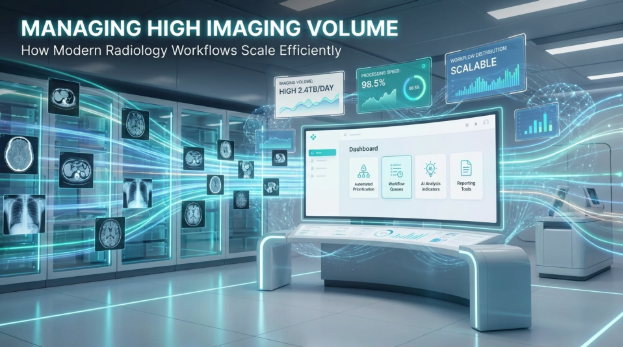
The Growing Pressure on Radiology Workflows
Imaging volumes are rising due to preventive care, chronic disease monitoring, and better access in smaller cities. However, the number of radiologists hasn't kept pace, leading to longer turnaround times, heavier workloads, and increased burnout risk.
This pressure builds across the workflow—studies pile up, inefficiencies turn into bottlenecks, and radiologists spend more time managing queues than interpreting cases. Many systems still rely on manual, fragmented processes that don't scale effectively.
Modern workflows solve this through integration and continuity, ensuring seamless data flow and reducing manual effort—making it possible to handle higher volumes efficiently.
Why Traditional Workflows Fall Short
In many setups, radiology workflows still depend on fragmented systems and manual coordination. Patient data may be entered multiple times, case assignments are often done manually, and report generation can be time-consuming.
As volumes increase, these inefficiencies become more visible. Delays start to build up, communication gaps widen, and maintaining consistency in reporting becomes difficult. Simply pushing teams to work faster is not a sustainable solution.
What is needed is a shift from manual, linear processes to intelligent, automated workflows that can adapt to increasing demand.
The Role of Automation in Scaling Workflows
Automation is one of the most important enablers of scalability in modern radiology. By reducing manual intervention, it allows teams to handle higher volumes without a proportional increase in effort.
For example, automated case allocation ensures that incoming studies are assigned to the right radiologist based on expertise and availability. This eliminates the need for manual distribution and helps balance workloads across the team.
Similarly, automated workflow triggers can move cases through different stages—from acquisition to reporting—without delays. This keeps the entire process moving smoothly, even during peak volumes.
AI as a Force Multiplier
Artificial Intelligence plays a crucial role in helping radiology teams scale efficiently. Instead of replacing radiologists, AI acts as a support system that enhances productivity.
AI can pre-analyze scans, flag abnormalities, auto-capture measurements, and generate structured report drafts—allowing radiologists to focus on clinical decision-making rather than repetitive tasks.
Another key advantage is in reporting. AI-assisted tools can generate structured drafts based on imaging findings, reducing the time required to create reports. Radiologists can then review and finalize them, significantly improving turnaround times.
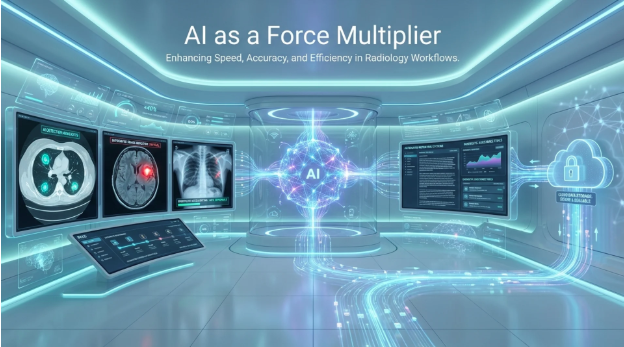
By handling repetitive and time-intensive tasks, AI allows radiologists to manage higher case volumes without compromising quality.
Cloud-Based Infrastructure for Flexibility
Scalability is closely linked to infrastructure. Traditional on-premise systems often struggle to keep up with growing data volumes and require frequent upgrades.
Cloud-based radiology platforms offer a more flexible approach. They allow healthcare providers to scale storage and computing resources based on demand, without large upfront investments.
Cloud systems also enable remote access, making it possible for radiologists to work from different locations. This is particularly useful for teleradiology setups, where cases can be distributed across a wider network of specialists. As imaging volumes fluctuate, cloud infrastructure ensures that the system can adapt without performance issues.
Data Management and Smarter Workload Balancing
Data management is a factor that directly affects scalability and is often underestimated. Imaging studies are inherently large, and as volumes increase, so does the demand for storage and retrieval. Without efficient data handling, systems slow down and costs rise disproportionately.
Improvements in how imaging data is stored and transmitted — including compression techniques that significantly reduce file sizes without compromising diagnostic usability — can make a meaningful difference. When each study requires less storage and can be accessed more quickly, the system is better equipped to handle sustained growth.
Beyond storage, cloud-based platforms also enable dynamic workload balancing. As volumes fluctuate across sites, cases can be distributed in real time rather than accumulating in isolated queues. This is particularly relevant for organizations operating across multiple locations or managing centralized reporting models.

Centralized Workflows Across Multiple Locations
Many hospitals and diagnostic chains operate across multiple centers. Managing imaging workflows across these locations can be complex, especially when each center operates independently.
Modern radiology systems enable centralized workflows, where cases from different locations are routed through a unified platform. This allows for better resource utilization and consistent reporting standards.
Radiologists can access and interpret scans from any center, reducing bottlenecks and ensuring that no location is overwhelmed. This centralized approach is essential for scaling operations without duplicating resources.
Standardization and Consistency
As volume increases, maintaining consistency in reporting becomes more challenging. Variations in report formats or interpretation styles can affect clinical decisions.
Modern workflows address this through structured reporting and standardized templates. These tools ensure that reports are clear, consistent, and aligned with clinical requirements. Standardization not only improves quality but also makes it easier to handle large volumes of cases without confusion or rework.
Real-Time Monitoring and Performance Insights
Scaling efficiently requires visibility into how workflows are performing. Modern systems provide real-time dashboards and analytics that help administrators track key metrics such as turnaround time, case volumes, and radiologist productivity.
These insights make it easier to identify bottlenecks and optimize processes. For example, if certain types of cases are causing delays, workflows can be adjusted to address the issue. Data-driven decision-making becomes a critical advantage when managing high volumes.
Reducing Burnout While Increasing Output
One of the less discussed but important aspects of scaling is the well-being of radiologists. High workloads and tight deadlines can lead to fatigue, which in turn affects accuracy and efficiency.
By automating repetitive tasks, improving case distribution, and providing decision support, modern workflows reduce the cognitive load on radiologists. This allows them to focus on complex cases and maintain a higher level of performance over time. Sustainable scaling is not just about handling more cases, but doing so in a way that supports the people behind the process.
Preparing for Future Growth
The demand for imaging is expected to continue rising in the coming years. Healthcare providers need systems that are not only capable of handling current volumes but are also prepared for future growth.
This means investing in scalable platforms that can evolve with changing needs. Whether it is integrating new technologies, expanding to new locations, or adopting advanced analytics, flexibility is key. Solutions like RadpicsAI are built with this future in mind, offering a unified approach that combines automation, AI, and cloud capabilities to support long-term scalability.
Final Thoughts
Managing high imaging volume is one of the biggest challenges in modern radiology. Traditional workflows are no longer sufficient to meet the demands of growing healthcare systems.
Efficient scaling requires a combination of automation, intelligent tools, flexible infrastructure, and well-designed processes. When these elements come together, radiology departments can handle increasing volumes without compromising on speed, accuracy, or quality.
As the healthcare landscape in India continues to evolve, adopting modern radiology workflows will be essential for providers looking to stay efficient, competitive, and patient-focused. Platforms like RadpicsAI are enabling this shift—helping radiology teams scale with confidence, consistency, and control.