


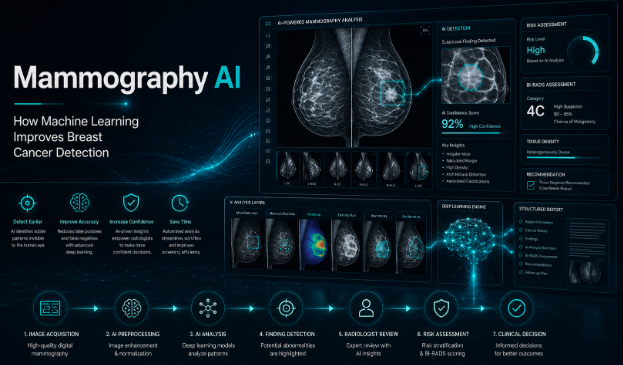
Breast cancer kills over 670,000 people annually - and a significant portion of those deaths trace back to one avoidable failure: a missed or delayed diagnosis on a mammogram. Mammography AI is changing that equation.
By combining machine learning with the established BI-RADS scoring system, AI tools like those built into RadpicsAI are helping radiologists catch what the human eye can miss — faster, and with greater consistency than ever before.
What Is Mammography AI, and Why Does It Matter Right Now?
Mammography has been the gold standard for breast cancer screening for decades. But it's not perfect. Radiologists reading hundreds of scans daily face fatigue, variability, and the inherent challenge of detecting subtle abnormalities in dense breast tissue.
Mammography AI steps in as a second reader — a tireless, pattern-trained assistant that flags suspicious regions, highlights micro-calcifications, and cross-references findings against millions of prior cases in milliseconds.
The result? Fewer false negatives. Fewer unnecessary biopsies. And faster turnaround on reports that patients are anxiously waiting for.
Understanding the BI-RADS Score: The Language AI Speaks
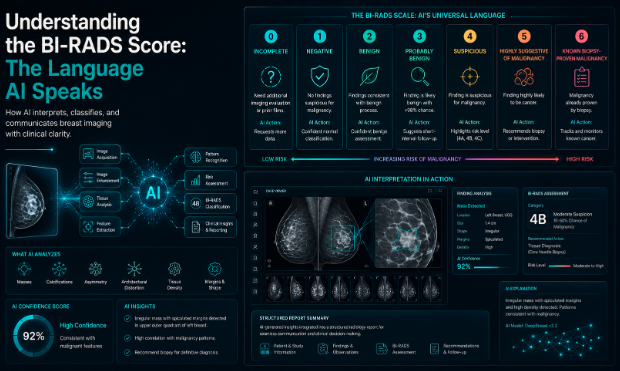
Before AI can help, it needs a shared language with radiologists. That language is BI-RADS — the Breast Imaging Reporting and Data System, developed by the American College of Radiology.
BI-RADS Categories at a Glance
| BI-RADS Score | Assessment | Recommended Action |
|---|---|---|
| 0 | Incomplete | Additional imaging needed |
| 1 | Negative | Routine annual screening |
| 2 | Benign | Routine annual screening |
| 3 | Probably Benign | Short-interval follow-up (6 months) |
| 4 | Suspicious | Tissue biopsy recommended |
| 5 | Highly Suggestive of Malignancy | Biopsy strongly recommended |
| 6 | Known Biopsy-Proven Malignancy | Treatment planning |
A BI-RADS calculator takes the subjective out of this classification. Instead of relying solely on one radiologist's interpretation, an AI-powered BI-RADS calculator analyzes lesion shape, margin, density, and distribution — then assigns a score grounded in statistical probability.
This doesn't replace the radiologist. It standardizes their starting point.
How Machine Learning Actually Works Inside a Mammography AI System
Most people imagine AI as a mysterious black box. In reality, modern mammography AI runs on well-understood deep learning principles:
- Convolutional Neural Networks (CNNs) — trained on hundreds of thousands of annotated mammograms to recognize visual patterns linked to malignancy
- Transfer Learning — pre-trained models adapted specifically to breast imaging datasets, reducing the need for massive proprietary data
- Ensemble Models — multiple algorithms cross-checking each other's outputs to reduce false positives
- Explainability Layers (XAI) — heatmaps and overlays that show radiologists exactly which region triggered a flag, building trust and enabling oversight
Platforms like RadpicsAI integrate these layers directly into the radiologist's workflow, meaning the AI output arrives alongside the image — not as a separate report that gets ignored.
The Real-World Impact: What the Data Shows
This is where theory meets clinical reality.
- A landmark study in Nature Medicine found that AI reduced false negatives by 9.4% compared to standard radiologist reads
- The FDA has cleared over 30 AI-based mammography tools as of 2025, signaling serious regulatory confidence in the technology
- In dense breast tissue — where cancer is hardest to spot — AI detection sensitivity improves by up to 20%
- Radiologist reading time per case drops by an average of 30–40 seconds with AI assistance, meaningfully improving throughput without cutting corners
For imaging centers handling 200+ studies per day, that time saving compounds into real capacity gains.
Why a BI-RADS Calculator Is the Practical Bridge Between AI and Clinical Decision-Making
A BI-RADS calculator is not a gimmick. It's the structured output layer that makes AI findings actionable.
Here's what a smart BI-RADS calculator does that raw AI output alone cannot:
- Translates probabilistic confidence scores into standardized clinical categories
- Flags edge cases (e.g., BI-RADS 3 vs. 4A decisions) where clinical context matters most
- Generates documentation-ready language for radiology reports
- Supports audit trails for quality assurance and peer review
When integrated into a platform like RadpicsAI, the BI-RADS calculator becomes a live decision-support tool — not a post-hoc label applied after the fact.
Common Barriers to AI Adoption in Mammography (And How They're Being Solved)
Despite the evidence, many imaging centers still hesitate. The objections are understandable:
- "Radiologists won't trust it." → Modern AI shows its work. Explainability features let radiologists verify AI reasoning before accepting or overriding findings.
- "Our workflow can't absorb another tool." → Purpose-built integrations with existing PACS and RIS systems mean zero new software to learn for the radiologist.
- "It'll increase liability." → The opposite is increasingly true. Documented AI-assisted reads create cleaner audit trails and demonstrate due diligence.
- "AI has high false positive rates." → Early systems did. Current generation tools, especially ensemble models, are calibrated specifically to reduce over-flagging.
5 Trending FAQs About Mammography AI
Frequently Asked Questions
Can mammography AI replace a radiologist?
No — and it's not designed to. AI functions as a second reader that augments radiologist judgment, catches fatigue-related oversights, and standardizes scoring. The radiologist always makes the final call.
What does a BI-RADS score of 4 actually mean?
BI-RADS 4 means the finding is suspicious enough to warrant a biopsy. It's subdivided into 4A (low suspicion), 4B (moderate), and 4C (high) — each carrying different probability of malignancy. A BI-RADS calculator helps place findings accurately within this range.
Is mammography AI accurate for dense breasts?
Yes — in fact, dense breast tissue is where AI provides the most value. Dense breasts mask tumors from human readers far more than fatty tissue does. AI trained on dense-tissue datasets significantly improves sensitivity in this challenging population.
How do I know if an AI mammography tool is FDA-cleared?
The FDA maintains a public database of cleared AI/ML-based medical devices. Any reputable mammography AI vendor — including RadpicsAI — should be able to provide their 510(k) clearance documentation on request.
What's the difference between a BI-RADS calculator and a standard AI risk score?
A raw AI risk score gives you a probability (e.g., 73% likelihood of malignancy). A BI-RADS calculator translates that into a standardized, clinically actionable category with defined next steps — making it far more useful in a real-world radiology workflow.
Where Mammography AI Is Headed Next
The next frontier isn't better detection — it's prediction. Emerging models are being trained not just to find existing cancer, but to identify mammographic patterns that precede cancer development by 2–5 years.
Pair that with longitudinal AI that tracks changes across a patient's screening history, and the BI-RADS calculator evolves from a scoring tool into a personalized risk engine.
For radiologists, imaging centers, and the patients they serve, that's not a distant possibility. With platforms like RadpicsAI pushing this space forward, it's the direction the entire field is moving — right now.