


Introduction
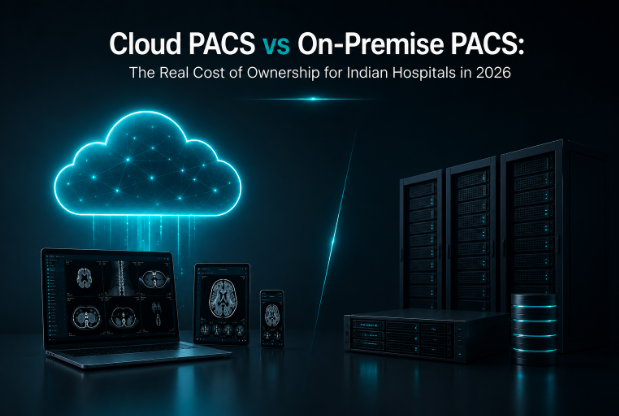
As Indian healthcare continues its digital transformation journey, hospitals and diagnostic centers are generating more imaging data than ever before. A single CT scanner can produce thousands of images daily, while MRI, mammography, and ultrasound studies add to the rapidly growing archive of medical data.
For healthcare administrators, choosing a PACS is no longer just an IT decision-it is a long-term business decision that directly impacts operational costs, radiologist productivity, scalability, and patient care.
Traditionally, hospitals relied on on-premise PACS systems, investing heavily in servers, storage infrastructure, backup systems, and IT resources. However, the emergence of cloud-native platforms is challenging the assumption that owning infrastructure is always the most cost-effective approach.
In 2026, the question is no longer:
"Which PACS should we buy?"
The real question is:
"Which PACS model will cost us less over the next five years while helping us scale?"
To answer that, hospitals need to evaluate the Total Cost of Ownership (TCO)-the complete financial impact of operating a PACS over its lifetime.
Why Most Hospitals Underestimate PACS Costs
When evaluating PACS solutions, many healthcare organizations focus primarily on licensing costs.
However, the software itself often represents only a fraction of the total investment.
The actual cost of PACS includes:
- Hardware procurement
- Storage expansion
- IT staffing
- Annual maintenance contracts
- Backup infrastructure
- Disaster recovery systems
- Software upgrades
- Cybersecurity measures
- Downtime costs
- Energy consumption
A PACS that appears affordable initially can become significantly more expensive over time.
This is why TCO has become one of the most important metrics in healthcare technology planning.
Understanding On-Premise PACS
An on-premise PACS is installed within the hospital's own infrastructure.
The hospital owns and manages:
- Physical servers
- Storage arrays
- Backup systems
- Network equipment
- Security infrastructure
- Disaster recovery solutions
Historically, this model provided healthcare organizations with complete control over their data and infrastructure.
For many years, it was the only practical option available.
However, ownership also means responsibility-and responsibility comes with cost.
Understanding Cloud PACS
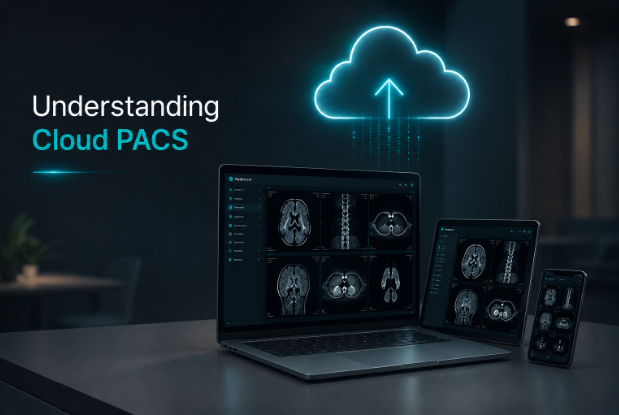
Cloud PACS shifts infrastructure management away from the hospital and into secure cloud environments.
Instead of investing in expensive hardware, healthcare providers access imaging data through secure internet-based platforms.
Modern cloud solutions allow radiologists to:
- View studies remotely
- Access images instantly
- Collaborate across locations
- Scale storage as needed
- Receive automatic software updates
Platforms like RadpicsAI take this a step further by combining PACS, reporting, AI tools, workflow automation, and cloud accessibility into a single ecosystem.
Cost Category #1: Initial Investment
This is often where the biggest difference appears.
On-Premise PACS
Before the first image is stored, hospitals typically need to invest in:
- High-performance servers
- Storage hardware
- Backup appliances
- Networking equipment
- Data center infrastructure
- Installation and deployment services
For medium-to-large hospitals, these costs can be substantial.
Cloud PACS
Cloud deployments eliminate most infrastructure requirements.
Hospitals can begin operations without purchasing expensive hardware.
The result is significantly lower upfront expenditure.
Winner: Cloud PACS
Cost Category #2: Storage Growth
Medical imaging data never stops growing.
A hospital performing hundreds of scans daily can generate several terabytes of new imaging data every year.
On-Premise PACS
Storage expansion requires:
- New hardware purchases
- Installation costs
- Configuration time
- Data migration projects
Many hospitals underestimate how quickly storage demands increase.
Cloud PACS
Cloud storage expands automatically.
Organizations pay for what they use without making large capital investments.
As imaging volumes grow, scalability becomes significantly easier.
Winner: Cloud PACS
Cost Category #3: IT and Maintenance Expenses
This is one of the most overlooked areas of PACS ownership.
On-Premise PACS
Hospitals need skilled IT teams to:
- Monitor servers
- Install updates
- Manage backups
- Resolve hardware failures
- Handle security patches
These recurring costs continue throughout the system's lifecycle.
Cloud PACS
Most maintenance responsibilities are managed by the provider.
Software updates, security patches, and infrastructure monitoring happen automatically.
This reduces both cost and complexity.
Winner: Cloud PACS
Cost Category #4: Downtime and Business Risk
Many healthcare organizations fail to account for the cost of downtime.
When PACS becomes unavailable:
- Reporting slows down
- Radiologists lose access to studies
- Clinicians experience delays
- Patient care may be affected
On-Premise PACS
Hardware failures can require:
- Emergency repairs
- Server replacements
- Data restoration
Recovery may take hours or even days.
Cloud PACS
Leading cloud platforms use redundancy across multiple environments.
This significantly reduces downtime risk and improves business continuity.
Winner: Cloud PACS
Cost Category #5: Multi-Center Expansion
India is witnessing rapid growth in hospital chains and diagnostic networks.
Many organizations now operate across multiple cities and locations.
On-Premise PACS
Every new location often requires:
- Additional infrastructure
- Network configuration
- Storage deployment
- Local maintenance support
Expansion becomes increasingly expensive.
Cloud PACS
New locations can be connected quickly through centralized infrastructure.
This enables healthcare organizations to scale efficiently.
Winner: Cloud PACS
The Hidden Cost Nobody Talks About: Radiologist Productivity
Infrastructure costs are visible.
Productivity losses are not.
When radiologists experience:
- Slow image loading
- Complex workflows
- Limited remote access
- Fragmented systems
the hospital loses valuable reporting capacity.
A few minutes lost per case can translate into hundreds of lost reporting hours annually.
This hidden operational cost often exceeds infrastructure expenses.
Why Cloud PACS Is Becoming the Preferred Choice in India
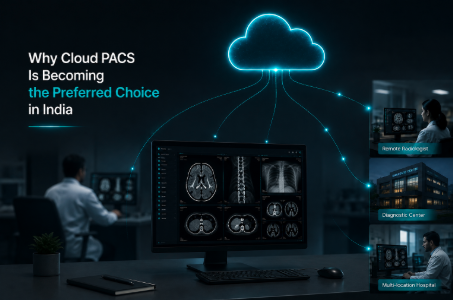
Indian healthcare providers are facing:
- Rising imaging volumes
- Shortage of radiologists
- Growing teleradiology adoption
- Increasing patient expectations
- Pressure to reduce operational costs
Cloud PACS aligns naturally with these requirements because it offers:
- Faster deployment
- Lower capital expenditure
- Easier scalability
- Remote accessibility
- Better disaster recovery
- Predictable operational costs
This is why cloud adoption is accelerating across hospitals and diagnostic chains.
How RadpicsAI Changes the Economics of PACS
RadpicsAI is not just a cloud storage platform.
It is a complete radiology workflow ecosystem designed to reduce both direct and indirect operational costs.
Cloud-Native Infrastructure
No expensive server investments or ongoing hardware management.
Integrated Reporting
Images and reports exist within the same platform, reducing workflow friction.
AI-Powered Efficiency
Built-in AI tools help accelerate reporting and improve productivity.
Anywhere Access
Radiologists can securely access studies from hospitals, reporting centers, or remote locations.
Seamless Scalability
Storage and users can grow without requiring major infrastructure upgrades.
Reduced Total Cost of Ownership
By combining PACS, reporting, AI, workflow automation, and cloud accessibility, RadpicsAI helps hospitals lower operational expenses while improving efficiency.
Conclusion
The PACS conversation in 2026 is no longer about where images are stored.
It is about creating a sustainable, scalable, and cost-effective radiology operation.
While on-premise systems may still suit some organizations, the long-term economics increasingly favor cloud-based solutions.
When infrastructure, maintenance, scalability, downtime, and productivity are all considered, Cloud PACS consistently delivers a lower Total Cost of Ownership for most Indian hospitals.
For healthcare organizations looking to future-proof their imaging infrastructure, solutions like RadpicsAI offer more than technology-they provide a pathway to smarter operations, faster reporting, and sustainable growth.
FAQs
Frequently Asked Questions
Is Cloud PACS cheaper than On-Premise PACS?
In most cases, yes. Cloud PACS reduces infrastructure, maintenance, upgrade, and scalability costs, resulting in a lower long-term TCO.
What is the biggest hidden cost of On-Premise PACS?
Storage expansion, IT staffing, downtime, and infrastructure upgrades are often underestimated.
Is Cloud PACS secure for hospitals?
Yes. Modern cloud platforms use enterprise-grade encryption, access controls, backups, and security monitoring.
Why are Indian hospitals moving to Cloud PACS?
To reduce capital expenditure, support remote reporting, improve scalability, and simplify IT management.
How does RadpicsAI help reduce PACS costs?
RadpicsAI eliminates hardware dependency, reduces maintenance requirements, streamlines workflows, and improves radiologist productivity through a cloud-native, AI-powered platform.