


In the rapidly evolving landscape of Indian healthcare, the transition from traditional film-based X-rays to digital imaging is no longer a luxury — it is a necessity. At the heart of this transformation is PACS (Picture Archiving and Communication System).
If you are a hospital administrator or a radiologist in India looking to streamline your diagnostic workflow, this guide will help you understand what makes a PACS "the best" and why modern AI-integrated solutions are leading the charge.
What is PACS Software?
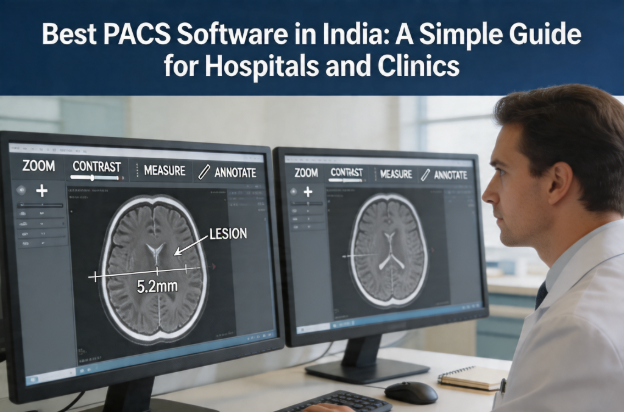
PACS is a healthcare technology that provides economical storage and convenient access to images from multiple modalities — source machine types such as Ultrasound, Magnetic Resonance (MR), Nuclear Medicine imaging, Positron Emission Tomography (PET), Computed Tomography (CT), and Mammography.
Key Features to Look for in the Best PACS Software
When searching for the best PACS software in India, consider these critical factors:
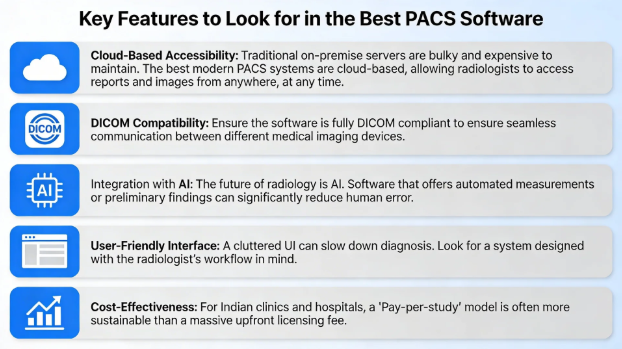
- Cloud-Based Accessibility: Traditional on-premise servers are bulky and expensive to maintain. The best modern PACS systems are cloud-based, allowing radiologists to access reports and images from anywhere, at any time.
- DICOM Compatibility: Ensure the software is fully DICOM (Digital Imaging and Communications in Medicine) compliant to ensure seamless communication between different medical imaging devices.
- Integration with AI: The future of radiology is AI. Software that offers automated measurements or preliminary findings can significantly reduce human error.
- User-Friendly Interface: A cluttered UI can slow down diagnosis. Look for a system designed with the radiologist's workflow in mind.
- Cost-Effectiveness: For Indian clinics and hospitals, a "Pay-per-study" model is often more sustainable than a massive upfront licensing fee.
- Teleradiology: Enables remote access to medical images, allowing faster reporting and round-the-clock diagnostic support.
- HIS/RIS Integration: Ensures seamless data flow between systems, improving efficiency and reducing manual errors.
Why RadPicsAI is Redefining Imaging in India
While there are many international players, RadpicsAI stands out as a specialized solution tailored for the modern diagnostic environment. Unlike traditional systems,RadpicsAI focuses on the "Smart" aspect of imaging.
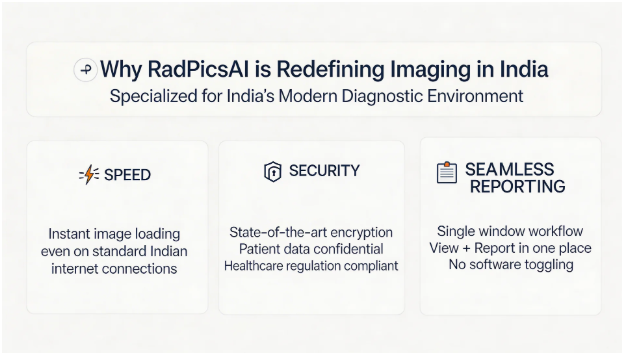
- Speed: With high-speed rendering, images load instantly even on standard Indian internet connections.
- Security & Compliance: State-of-the-art encryption ensures that patient data remains confidential and compliant with healthcare regulations.
- Integrated Viewing & Reporting: It integrates viewing and reporting in a single window, eliminating the need to toggle between different software.
Benefits for Indian Hospitals and Clinics
- Reduced Physical Storage: Eliminate the need for darkrooms and physical film storage.
- Faster Turnaround Time (TAT): Digital distribution of images means patients get their reports faster, leading to quicker treatment.
- Tele-Radiology Support: Small clinics in rural India can send images to expert radiologists in metropolitan cities instantly via a robust PACS.
Conclusion: Choosing the Right Partner
The "best" PACS isn't just the one with the most features — it's the one that fits your clinic's volume and your doctor's needs. For Indian healthcare providers looking to bridge the gap between quality and affordability, cloud-native platforms like RadpicsAI are the way forward.
Investing in a high-quality PACS today ensures your facility is future-ready, scalable, and capable of providing the highest standard of patient care.
Frequently Asked Questions
What is the difference between PACS and RIS?
While often used together, they serve different purposes:
• PACS (Picture Archiving and Communication System): Focuses on the storage, retrieval, distribution, and presentation of medical images (X-rays, MRIs, CT scans).
• RIS (Radiology Information System): Manages the "business" side of the radiology department, including patient scheduling, billing, and tracking medical records.
Is Cloud-based PACS better than On-premise PACS?
For most Indian clinics and hospitals, Cloud-based PACS is superior because:
• Lower Cost: No need for expensive local servers or dedicated IT staff.
• Remote Access: Radiologists can view and report on cases from home or another city.
• Security: Data is backed up automatically in secure data centers, protecting against local hardware failure.
How does PACS improve Patient Care?
PACS significantly reduces the Turnaround Time (TAT) for reports. Instead of waiting for films to be developed and physically transported, digital images are available to specialists instantly. This leads to faster diagnosis and quicker initiation of treatment.
Can PACS software integrate with my existing Hospital Management System (HMS)?
Yes, modern PACS like RadpicsAI are designed to be highly compatible. Using industry-standard protocols like HL7 and DICOM, the PACS can sync with your existing HMS or EMR to ensure patient data flows seamlessly between departments.
What are the bandwidth requirements for using Cloud PACS in India?
Modern systems use advanced compression technology. While a stable internet connection is required, most high-quality PACS can function efficiently on standard broadband or high-speed 4G/5G connections, allowing for smooth image rendering even in Tier-2 and Tier-3 cities.
Is PACS software legally compliant in India?
Yes, reputable PACS providers ensure compliance with data privacy standards and healthcare regulations. They provide secure, encrypted environments for storing sensitive patient health information (PHI).