


The radiology report is the end product of everything that happens in an imaging department. The scan, the upload, the worklist, the viewer, the hanging protocols all of it exists to get one radiologist, looking at one study, to produce one clear, accurate, timely report that a clinician can act on.
Which makes the choice of reporting software more important than most departments give it credit for. Radiologists spend the majority of their working hours in this tool. Its speed, its intelligence, and the friction it does or does not create directly determines how many studies get read per shift, how fast reports reach clinicians, and how quickly radiologists burn out.
In 2026, there are more options than ever. Here is how to make a decision that will hold up.
What has changed in radiology reporting software?
Three years ago, the primary question was cloud or on-premise. Today, that question has largely been settled cloud wins for most facilities, for reasons of cost, maintenance, and remote access. The interesting questions now are about what the software does with AI, how well it integrates with everything around it, and whether it genuinely fits the way radiologists actually work.
Modern reporting software is no longer just a text box where radiologists type. It is an environment that orchestrates the entire reading session opening the study with the right images in the right layout, pulling AI findings into the report draft, managing the worklist intelligently, and delivering the completed report to clinicians and patients the moment it is signed.
If the software you are evaluating does not do all of those things, you are looking at yesterday's product.
The five things that actually matter when evaluating options
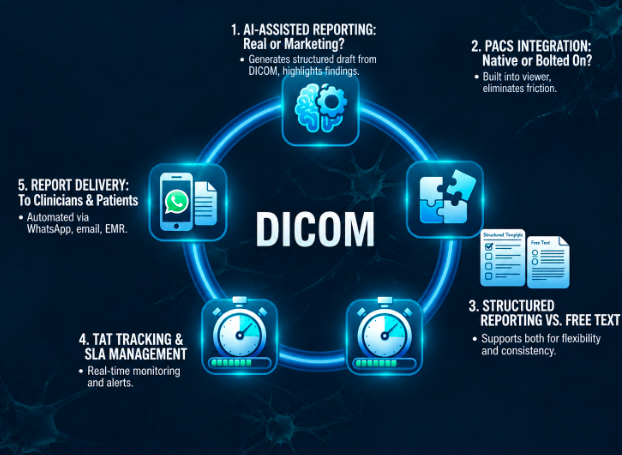
1. AI-assisted reporting — real or marketing?
Every vendor will tell you they have AI. The question is what the AI actually does in the reporting workflow.
Meaningful AI does one or more of these things: it generates a structured report draft based on the modality and findings, so the radiologist edits rather than types from scratch; it highlights findings in the image viewer that are then referenced in the report; or it flags when an impression seems inconsistent with the body of the report.
What AI should not do, and what some vendors unfortunately sell as a feature, is generate generic boilerplate text that the radiologist still has to completely rewrite. If the AI is producing paragraphs that need to be replaced rather than refined, it is not saving time it is adding a step.
RadpicsAI's AI reporting engine generates structured preliminary reports from DICOM image analysis. The radiologist opens the study and finds a draft already populated they review, adjust where their clinical judgement differs, and sign. The final report is theirs. The first draft is not.
2. PACS integration — native or bolted on?
Reporting software that is separate from your PACS creates friction at every step. The radiologist opens images in one application, switches to another to type the report, copies findings across, and then has to ensure the signed report finds its way back to the right patient record.
That is not a workflow. That is a workaround.
The best setup is reporting software that is built into the PACS so the image viewer and the reporting interface are the same window, the study and the report are linked automatically, and signing the report updates the patient record instantly. This is how MedPACS works: the reporting environment is part of the viewer, not a separate application.
3. Structured reporting vs. free text
Free-text reporting gives radiologists flexibility. Structured reporting gives clinicians consistency findings reported in the same format, in the same place, every time, which makes it dramatically easier to extract specific data points, track changes over time, and integrate reports with electronic health records.
The best reporting software supports both. Structured templates for high-volume routine studies chest X-rays, routine MRIs, standard CTs and free-text capability for complex or unusual cases. Forcing radiologists into rigid structured templates for every study is the fastest way to generate pushback from your team.
4. Turnaround time tracking and SLA management
Reporting software that cannot tell you, in real time, how long studies have been waiting and whether your team is on track against turnaround time targets is missing a critical operational feature.
For diagnostic centres with contractual turnaround commitments, for hospitals with clinical governance requirements, and for teleradiology networks managing SLAs across multiple clients the ability to monitor and manage report turnaround is not optional. It should be built into the reporting software, not tracked manually in a spreadsheet.
5. Report delivery — to clinicians and patients
A report that has been signed but not delivered is not useful. Reporting software should handle delivery automatically to the referring clinician's system, to the patient via WhatsApp or email, and into the patient's EMR record.
In India specifically, WhatsApp delivery has become a practical expectation. Patients expect to receive their report on their phone, the way they receive everything else.
Reporting software that cannot do this or that requires manual effort to deliver reports creates a gap between what the software can do and what patients expect.
Questions to ask any vendor during a demo
When you are sitting in a product demonstration, these are the specific questions that will reveal whether the software is genuinely built for clinical use or built to look good in a presentation:
Show me what happens from the moment I open a study to the moment the report is signed. Time it with me. Show me how AI findings appear in the report draft. Show me what a referring doctor receives after I sign. Show me how the system flags a study that has been waiting too long. Show me the worklist for a radiologist reading across multiple sites.
If any of those demonstrations involve the vendor saying "that feature is on the roadmap" make a note of it. Roadmap features are not features you are buying today.
Cloud deployment: what to check beyond the headline
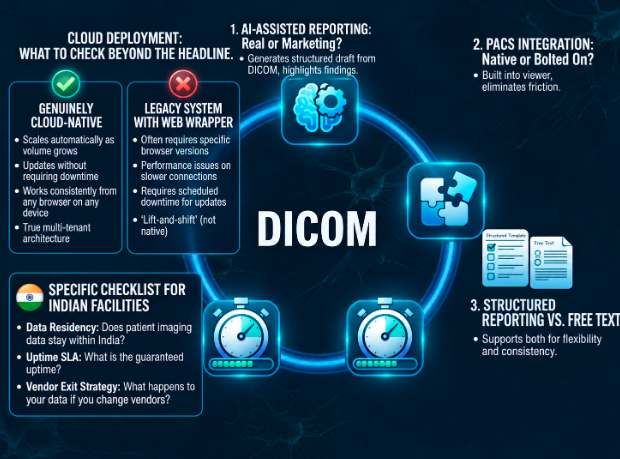
Most reporting software in 2026 is cloud-based. But cloud is not one thing and the difference between a genuinely cloud-native platform and a legacy system with a web front end matters considerably.
A genuinely cloud-native platform scales automatically as your volume grows, updates without requiring downtime, and works consistently from any browser on any device. A legacy system with a web wrapper often requires specific browser versions, has performance issues on slower connections, and requires scheduled downtime for updates.
For Indian facilities specifically, ask about data residency. Does patient imaging data stay within India? What is the uptime SLA? What happens to your data if you decide to change vendors?
How RadpicsAI's MedPACS handles reporting
RadpicsAI was built from the start as an integrated platform which means reporting is not a module added to a viewer. It is part of the same environment where images are opened, hung, and read.
Radiologists reading on MedPACS see the study with hanging protocols applied, AI findings already highlighted, and a preliminary report draft ready in the same window.
Structured templates are available for common study types and can be customised per radiologist or department. When the report is signed, it is delivered automatically — to the referring doctor, to the patient via their preferred channel, and to the patient's EMR record in MedCARE.
Turnaround time tracking is built in. Department administrators see real-time status across all pending studies. Studies approaching their SLA get flagged before they breach it, not after.
The bottom line
Radiology reporting software is not a commodity. The right platform reduces the time between study arrival and signed report, makes each radiologist more productive without increasing cognitive load, and delivers results to the people who need them the moment they are ready.
The wrong platform makes radiologists slower, creates reporting gaps, and generates support calls at inconvenient moments.
Evaluate it the way you would evaluate anything that your clinical team will use every single working day. See it in action with real studies. Time the critical steps. Ask the uncomfortable questions. And make sure the vendor you choose has Indian healthcare experience, Indian data residency, and support that answers when you call.
See how RadpicsAI fits.
FAQs
Frequently Asked Questions
What is radiology reporting software?
It is the environment where radiologists review medical images and produce clinical reports. Modern platforms integrate the image viewer, AI-assisted report drafting, worklist management, and report delivery in one system.
How does AI actually help with reporting?
AI analyses the images before the radiologist opens the study and generates a preliminary structured report draft. The radiologist reviews, adds clinical judgement, corrects any discrepancies, and signs. The result is faster reporting without replacing the radiologist's expertise.
Does reporting software need to be integrated with PACS?
Yes, for practical clinical use. Separate systems create manual steps, data duplication, and delays. An integrated platform where viewing and reporting happen in the same interface eliminates that friction entirely.
What is the difference between structured and free-text reporting?
Structured reports follow a predefined format findings in specific fields, consistent terminology. Free-text reports are written by the radiologist in their own words. The best platforms support both and let radiologists choose based on the study type.
Can reports be delivered directly to patients?
Yes, on platforms that support digital delivery. RadpicsAI delivers signed reports to patients via WhatsApp, email, and a patient portal automatically, the moment the report is signed.
What turnaround time tracking should I expect?
At minimum, real-time visibility into how long each study has been waiting, colour-coded SLA status across the worklist, and automated escalation when a study is approaching its target time. This should be built in, not require a separate reporting tool.
Is cloud-based reporting software secure for Indian hospitals?
Yes, when using platforms with end-to-end encryption, Indian data residency, role-based access controls, and audit logs. Always verify data residency and compliance before selecting a vendor.
How long does implementation take?
For cloud-based platforms, basic setup and radiologist onboarding typically takes one to two weeks. Full configuration structured templates, hanging protocols, delivery rules, and SLA settings is usually complete within a month.