


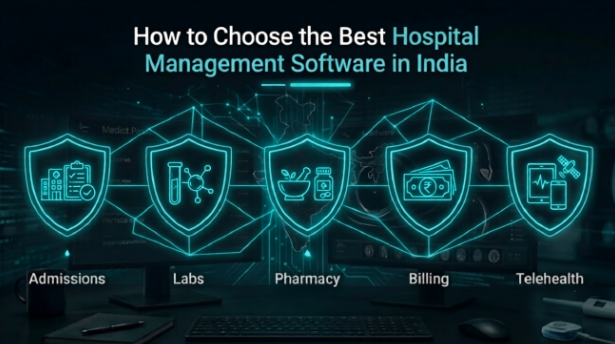
Every hospital has the same underlying problem. Information is scattered.
The OPD reception does not know what the pharmacy has in stock. The radiology department cannot see the lab results ordered for the same patient this morning. The billing team is manually re-entering data that was already entered at registration. And the hospital administrator has no real-time visibility into how any of this is actually performing.
Hospital Management Software - HMS - is what fixes that. One connected system that ties together every department: OPD, IPD, pharmacy, lab, radiology, billing, and administration. When it works well, information flows automatically, staff spend less time on paperwork, and patients experience a smoother, faster service.
But choosing the right HMS for your hospital is harder than it looks. There are dozens of options in India, each claiming to be the most comprehensive solution available. Here is a practical guide to making a decision you will not regret.
What should hospital management software actually do?
At a minimum, a complete HMS should handle: patient registration and OPD scheduling; IPD management including admissions, wards, and discharge; electronic medical records (EMR); lab and pharmacy management; radiology and imaging integration (RIS/PACS); billing with GST compliance and TPA/insurance claim management; inventory management; and reporting and analytics for administrators.
The word that matters most in that list is integrated. Individual software for each department might solve each problem in isolation - but if those systems do not communicate with each other, you have replaced paper silos with digital ones. The coordinator is still manually transferring information. The radiologist is still entering the same data in two places.
For hospitals with a radiology department, PACS integration is particularly important. Imaging orders, scan status, and radiology reports should flow through the HMS without any manual re-entry. RadpicsAI is built around this - MedPACS connects directly to patient and billing workflows, so imaging is part of the whole system rather than a separate island.
Start with your actual facility type
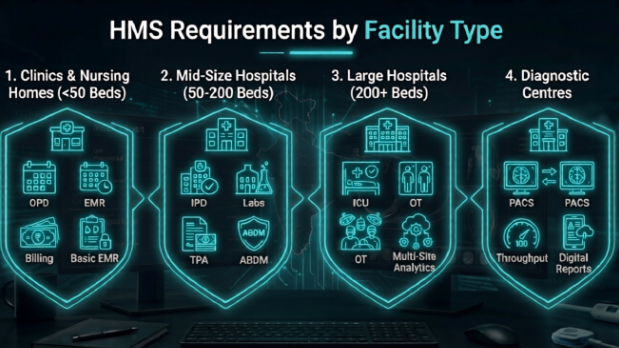
Not every hospital needs the same software. The most common mistake in HMS selection is evaluating enterprise-grade platforms against a 30-bed nursing home's requirements, or vice versa.
Small clinic or nursing home (under 50 beds)
Speed and simplicity matter above everything else. Staff do not have time to navigate complex menus. Look for clean OPD scheduling, fast billing, basic EMR, and a system your team can be productive on within a day or two of training. ICU management and multi-site analytics are features you do not need yet - and paying for them makes the system harder to use without adding value.
Mid-size hospital (50 to 200 beds)
You need more depth: IPD management, pharmacy and lab integration, TPA billing, and real-time reporting for administrators. ABDM compliance becomes important here, particularly if you are PMJAY-empanelled or working toward NABH accreditation.
Large or multi-speciality hospital (200+ beds)
Enterprise-grade requirements: role-based access for hundreds of staff, OT scheduling, ICU management, multi-department analytics, and robust integration with specialist systems. Implementation complexity increases significantly at this scale - factor in migration timelines, staff training, and ongoing IT support from the outset.
Diagnostic centre
Your focus is patient throughput, report delivery, billing, and PACS integration. A full hospital HMS may include functionality you will never use while missing specifics you actually need. A platform like RadpicsAI that combines PACS, EMR, and diagnostic centre management in one system often fits better than a general hospital HMS adapted for the purpose.
Five things to verify before signing any contract
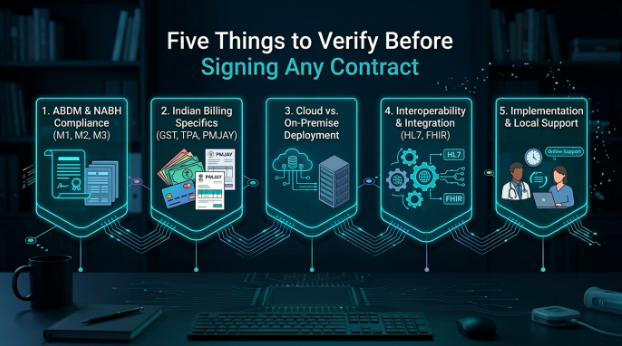
1. ABDM and NABH compliance - genuinely
ABDM compliance is required for PMJAY-empanelled hospitals. Ask specifically which milestones (M1, M2, M3) the vendor supports, whether FHIR R4 record export is live today, and whether ABHA number linking actually works in the demo you are being shown - not in a future release.
2. Indian billing specifics
GST-compliant invoicing, TPA claim management, PMJAY package billing, and standard Indian insurance formats - these need to work correctly out of the box. Test billing scenarios that match your actual patient mix during the demo. Billing errors are expensive and difficult to unwind after the fact.
3. Cloud vs. on-premise deployment
Cloud-based HMS means no server hardware, automatic updates, and access from any device. On-premise means more control over data but requires dedicated IT staff and infrastructure. For most new deployments in India in 2026, cloud is the practical choice. If you have specific data sovereignty requirements or limited internet reliability, on-premise may still be warranted - but be honest about the IT overhead that comes with it.
4. Integration with your existing systems
If you already have a PACS, a lab system, or a pharmacy system, check whether the HMS integrates with them - or whether replacing them is an implicit requirement. Integration via HL7 or FHIR standards is more reliable than custom point-to-point connections. A system that cannot connect to anything else will create new silos, not eliminate them.
5. Implementation support and ongoing training
Software that your team cannot use effectively is worse than no software. Ask specifically: How long does implementation take? Who runs the training? What does support look like six months after go-live? Local support - in your language and time zone - matters considerably when something breaks on a busy morning.
The ABDM factor: it is bigger than compliance
Many administrators treat ABDM as a regulatory checkbox. That is understandable, but it misses the bigger picture.
ABDM is building a national health data infrastructure. As more patients arrive with ABHA numbers already set up, a hospital that cannot link them is creating friction in the patient experience and missing the clinical benefit of portable health records.
The Digital Health Incentive Scheme also pays hospitals per ABHA-linked health record transaction. For a hospital seeing 150 patients a day, that adds up meaningfully over the course of a year. ABDM compliance is not just regulatory housekeeping - it is a direct operational advantage.
What about AI features?
HMS platforms are increasingly incorporating AI - voice documentation that transcribes consultations, predictive analytics that flag at-risk patients, automated billing anomaly detection.
For most hospitals evaluating HMS for the first time, AI is not the primary selection criterion. Get the fundamentals right first - reliable scheduling, clean billing, integrated records - and evaluate AI features once the foundation is solid.
The exception is radiology. AI-assisted imaging analysis - as offered through RadpicsAI's MedPACS - is increasingly becoming a practical consideration for radiology-focused facilities.
A practical evaluation checklist
When you run a demo or evaluation, test these specific scenarios rather than accepting a feature walkthrough:
- Register a new patient and link their ABHA number.
- Place an imaging request and track it through to report delivery.
- Generate a TPA billing invoice for an insured patient.
- Pull up a patient who visited six months ago.
- Run a report on last week's OPD volume by department.
- Simulate what happens when a radiologist signs a report - does it automatically appear in the patient record?
How the software handles these everyday moments tells you far more than the slide deck in the sales presentation.
Where RadpicsAI fits in this picture
RadpicsAI is not a full hospital HMS in the sense of managing OT scheduling or ICU beds for a 300-bed multi-speciality hospital. What it does exceptionally well is serve imaging-centric facilities: hospitals with radiology departments, diagnostic centres, and teleradiology networks.
MedPACS handles cloud imaging and AI diagnostics. MedCARE handles appointments and patient records. MedVIEWER gives referring doctors and patients access to images and reports from anywhere.
For facilities where radiology is the core business or a significant revenue centre, this integrated approach means imaging, records, and clinical workflow are managed in one place - rather than across separate systems that have to be manually kept in sync.
The bottom line
The right hospital management software does not exist in the abstract. It exists relative to your facility's size, your patient mix, your compliance obligations, and your existing systems.
Start with your actual workflow, not with a vendor's feature list. Be specific about what problems you are trying to solve. Test the critical scenarios in a real demo with real data. And make sure whoever you are buying from will be there - genuinely, responsively - after the contract is signed.
In 2026, hospitals that are growing efficiently and serving patients well are the ones with connected, digital operations. HMS is how you build that foundation.
FAQs
Frequently Asked Questions
What is hospital management software?
It is an integrated digital platform that manages all hospital departments - patient registration, OPD, IPD, pharmacy, lab, radiology, billing, and administration - in one connected system rather than separate tools for each department.
Is HMS mandatory for Indian hospitals?
Not universally, but ABDM compliance is required for PMJAY-empanelled hospitals, and NABH accreditation expects electronic records. The regulatory direction is clearly toward fully digital operations.
What is ABDM compliance and does my hospital need it?
ABDM compliance allows hospitals to link patient records to ABHA numbers and share data in FHIR format. All PMJAY-empanelled hospitals must comply, and the Digital Health Incentive Scheme pays per ABHA-linked record - making compliance both mandatory and financially beneficial.
Cloud or on-premise - which is better for Indian hospitals?
For most Indian hospitals in 2026, cloud-based HMS is the better starting point - lower upfront cost, no server maintenance, and access from any device. On-premise may suit hospitals with specific data sovereignty needs or limited internet reliability.
How long does HMS implementation take?
For smaller facilities, basic setup can be done in a week or two. Full implementation - including data migration, billing configuration, and staff training - typically takes two to eight weeks depending on the facility's scale and complexity.
Does RadpicsAI offer full hospital management software?
RadpicsAI is built for imaging-centric facilities - hospitals with radiology departments, diagnostic centres, and teleradiology networks. It covers PACS, EMR, appointments, records, and video consultation. For full multi-department hospital operations such as OT and ICU, it works best alongside or integrated with a broader HMS.
How much does HMS cost in India?
Pricing varies widely - from a few thousand rupees per month for small clinics to several lakhs for enterprise installations. Most cloud-based HMS platforms use subscription pricing. Always get itemised quotes and confirm what is included in the base price versus what is charged as an add-on.
What is the single most important thing to check in a demo?
Billing - specifically TPA billing, GST invoicing, and how the system handles your actual patient mix. Billing errors are expensive and hard to unwind. Verify this before committing to any platform.