


India has around 20,000 radiologists serving a population of over 1.4 billion - and the gap is especially severe beyond major cities.
That gap is not a projection. It is the reality right now, today, in hospitals and diagnostic centres across the country. And it is not closing fast enough. Meanwhile, imaging volumes keep climbing - more CT scans, more MRIs, more X-rays - driven by Ayushman Bharat coverage, rising chronic disease burden, and a population of 1.4 billion people who are increasingly aware that catching something early makes a difference.
Something has to bridge that gap. AI healthcare imaging platforms are doing exactly that - quietly, practically, and at a scale that would have been impossible five years ago.
So What Actually Is an AI Healthcare Imaging Platform?
Strip away the jargon and it is simpler than it sounds. An AI healthcare imaging platform is a software system that combines three things: medical image storage, AI-powered analysis, and clinical workflow tools - all in one cloud-based environment.
Think of it as a complete digital radiology department that never sleeps, never tires after a ten-hour shift, and gets a little smarter with every study it processes.
When a patient gets a scan, the images are uploaded instantly. AI reviews them for abnormalities. A radiologist - who might be sitting in the same building, or in a different city entirely - opens the study, sees the AI's findings already highlighted, reviews them with their own clinical eye, and signs the final report.
That is the loop. And platforms like RadpicsAI make that loop work seamlessly for Indian hospitals, diagnostic centres, and teleradiology networks - combining cloud PACS, AI diagnostics, EMR, appointment management, and video consultation in a single integrated system.
How Does It Work, Step by Step?
Step 1: The Scan Is Taken
A patient gets a CT, MRI, X-ray, or ultrasound at any connected facility. The images come straight from the scanner.
Step 2: Images Go to the Cloud Instantly
Instead of sitting on a local server - or worse, being printed on film and handed over in a brown envelope - the images are uploaded to a cloud PACS the moment the scan is complete. Anyone with the right access can open them from anywhere. A radiologist in Pune can read a study from a clinic in Raipur within minutes of it being done.
Step 3: AI Does a First Pass
The AI engine scans every image for anything unusual - a fracture, a nodule, a mass, a haemorrhage. It flags what it finds and, crucially, it prioritises. A suspected intracranial bleed does not wait behind a stack of routine chest X-rays. It goes to the top.
Step 4: The Radiologist Reviews and Reports
The radiologist opens the study in MedPACS - MedVIEWER - and sees the AI's findings already marked. They bring their clinical judgement to bear, refine the interpretation, and sign the report. AI produces the first draft; the radiologist produces the final word.
Step 5: The Report Reaches the Patient
The completed report goes back to the referring doctor and directly to the patient. No waiting for a CD to be burned. No paper files. No second trip to the centre to collect a printout. Everything is accessible digitally, immediately.
Why Does This Matter So Much for India, Specifically?
The radiology shortage is not evenly distributed. Most specialist radiologists are concentrated in a handful of large cities. A patient in Amravati, Gorakhpur, or a small town in Odisha often cannot access one at all - or waits days for a report that someone in Mumbai would receive the same afternoon.
AI imaging platforms change that equation. A scan taken at a small clinic anywhere in the country can be uploaded instantly, reviewed by AI, and then checked by a specialist radiologist working remotely. The patient gets their result the same day - without travelling, without waiting, without the uncertainty that comes with delays.
Government initiatives are accelerating this. The Ayushman Bharat Digital Mission is pushing hospitals toward digital health records. The Strategy for AI in Healthcare (SAHI), launched in 2026, is actively encouraging safe and scalable AI adoption across Indian healthcare. Hospitals that have not started this transition are not standing still - they are falling behind.
What Can AI Actually Detect?
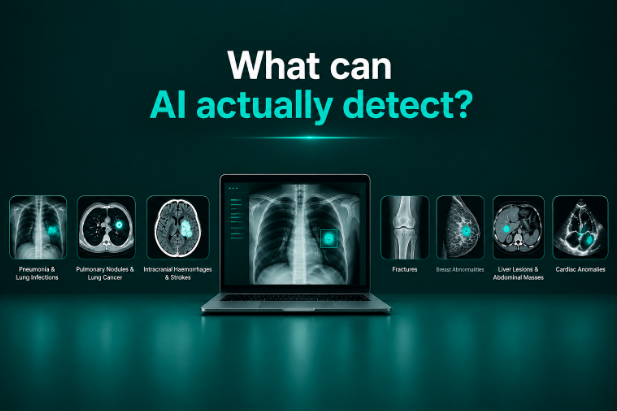
This is the question most hospital administrators ask first, and it is a fair one. AI imaging tools today have demonstrated strong, clinically validated performance across a wide range of findings:
- Pneumonia and lung infections on chest X-rays
- Pulmonary nodules and early-stage lung cancer on CT
- Intracranial haemorrhages and strokes on brain CT
- Fractures, including subtle ones that are easy to miss after a long shift
- Breast abnormalities on mammography
- Liver lesions and abdominal masses on CT and MRI
- Cardiac anomalies on echocardiography
The important word here is detect. AI flags findings for a radiologist to review. It does not replace clinical judgement - it makes sure clinical judgement gets applied to things that might otherwise be overlooked.
Who Actually Needs This?
Large hospitals dealing with high volumes and radiologist shortages. AI triage means urgent cases get read faster, even when the queue is long.
Diagnostic centres in Tier 2 and Tier 3 cities. AI bridges the gap between local imaging capacity and specialist reporting - making same-day results achievable without a full-time specialist radiologist on site.
Teleradiology networks. Remote radiologists need reliable image access and AI-assisted workflows to manage high study volumes across multiple centres efficiently.
Insurers and government health programmes. Faster, more accurate reporting means faster treatment, fewer complications, and lower costs downstream.
RadpicsAI is built to serve all of these - whether it is a 500-bed hospital running 300 studies a day or a two-room diagnostic centre in a small town just starting its digital journey.
Is This Going to Be Expensive?
This is where many healthcare providers are pleasantly surprised.
Traditional PACS systems required significant upfront investment in server hardware, software licences, and dedicated IT staff. For most smaller centres, that was never realistic.
Cloud-based platforms like RadpicsAI work on a subscription model. You pay based on your usage and scale up as your volume grows. No servers to buy. No IT team to maintain them. Even a single diagnostic centre can access the same AI and PACS capabilities that were previously available only to large private hospital chains.
Will AI Replace Radiologists?
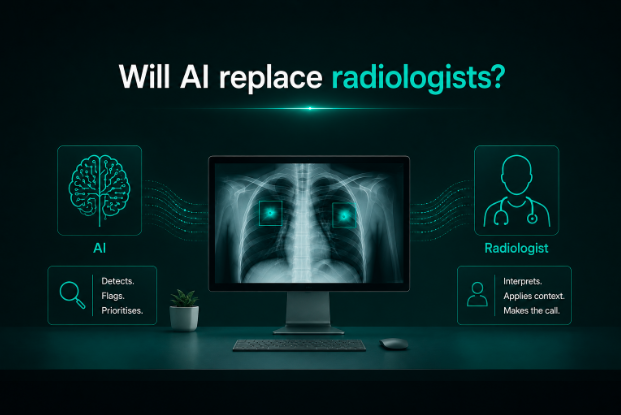
No. This question comes up every time AI enters a clinical field, and the answer is consistently the same.
AI handles the pattern-recognition layer - scanning images at scale, flagging abnormalities, prioritising what needs urgent attention. The radiologist handles the complex cases, the clinical context, the edge cases that do not fit the pattern, and the final diagnostic responsibility.
The better way to think about it is amplification. A radiologist working with AI can read more studies per day, catch more findings, and do it with less cognitive fatigue than one working without it. In a country where there are nowhere near enough radiologists, that amplification matters enormously.
The Bottom Line
AI healthcare imaging platforms are not something Indian hospitals will adopt at some point in the future. They are what the hospitals growing efficiently and serving patients well are already using.
The radiology shortage is not going away. Imaging volumes are not going down. The only sustainable way to close the gap - to make diagnostic imaging genuinely accessible to patients across the country - is with technology that makes each radiologist more capable and each scan more reachable.
That is exactly what RadpicsAI is built to do. If you want to see it in action, book a free demo and we will show you how it works with your own study types.
FAQs
Frequently Asked Questions
What is an AI healthcare imaging platform?
It is a cloud-based system that stores medical images, analyses them using AI, and lets radiologists report from anywhere. It combines PACS, AI diagnostics, EMR, and clinical tools in one place - rather than stitching together separate systems.
How is it different from a regular PACS?
A traditional PACS stores and displays images. An AI imaging platform also analyses those images automatically, flags abnormalities, prioritises urgent cases, supports teleradiology, and connects imaging to patient records - all integrated.
Can smaller diagnostic centres in India afford this?
Yes. Cloud-based subscription pricing means no heavy upfront hardware investment. Small centres can start at a scale that fits their budget and expand as their patient volume grows.
Does AI replace radiologists?
No. AI assists radiologists - it flags findings and handles the repetitive pattern-recognition work. A qualified radiologist always reviews and signs the final report. Think of AI as the world's most attentive first reader.
Which scan types can AI analyse?
Most platforms cover X-ray, CT, MRI, and ultrasound. RadpicsAI also supports mammography and handles DICOM images from any modality.
Is patient data safe on a cloud imaging platform?
Yes, when using a reputable platform with enterprise-grade encryption, strict access controls, and data residency in India. Always verify compliance before committing to any provider.
What is ABDM and why does it matter for imaging?
ABDM - the Ayushman Bharat Digital Mission - is India's national digital health programme. Platforms integrated with ABDM allow imaging reports to be linked to a patient's ABHA number and accessed across providers with the patient's consent.
How quickly does AI analyse a scan?
Typically within seconds of the images being uploaded. The radiologist then reviews the findings and finalises the report - significantly faster than manual reading alone, particularly for high-volume workflows.